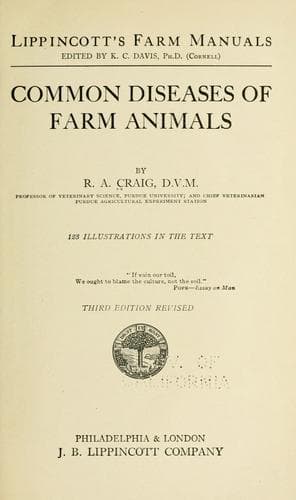
Common Diseases of Farm AnimalsCraig, Robert Alexander
Science
Common Diseases of Farm Animals
Craig, Robert Alexander
Veterinary medicine
_The hair varies_ in length, thickness and coarseness in the different
species, and the different regions of the body. In addition, breeding,
care, heat and cold may cause marked variations in the thickness of the
coat. Exposure to cold causes the coat to thicken. High temperatures cause
the short hairs to drop out and the coat to become thin.
Diseases of the skin may be _classified as parasitic_ and _non-parasitic_.
Parasitic skin diseases are caused by animal and vegetable parasites.
Non-parasitic skin diseases are caused by irritation to the skin and
internal causes. Irritation to the skin may be either chemical, thermic or
mechanical. The internal causes may be due to an individual predisposition
together with digestive disturbances and the eating of feeds too rich in
protein. In this chapter parasitic skin diseases produced by insects will
not be discussed.
FALLING OUT OF THE HAIR AND FEATHERS.--Falling out of the hair and feathers
frequently occurs independent of parasitic diseases. This condition does
not occur as an independent disorder, but as a secondary affection. It is
due to faulty nutrition, and irritation to the skin. Intestinal diseases,
insufficient feed and feed of bad quality are common causes. Animals that
are fed a heavy ration, or that lie on dirty, wet bedding frequently lose
large patches of hair. Sheep that are dipped in late fall and early winter,
or exposed to wet, cold weather may lose a part of their fleece. It is not
uncommon for animals toward the latter period of pregnancy, or that sweat
freely, to lose patches of hair.
Falling out of the hair heals of itself within a few weeks.
_The preventive measures_ are of special importance in sheep and horses.
This consists in avoiding conditions that may lead to alopecia and in
correcting the diet. In horses the regions of the mane and tail should be
washed with soap, or rubbed with alcohol and spirits of camphor, equal
parts. Treatment should be persisted in for a long period if necessary.
URTICARIA, "NETTLERASH."--Urticaria is characterized by roundish elevations
that appear quickly and become scattered over a part or the whole surface
of the skin. They are caused by an inflammatory infiltration of the deeper
layers of the skin. Horses and hogs are most frequently affected.
_The causes_ of urticaria are irritating juices of certain plants,
secretions of flies, ants and some caterpillars, irritating drugs,
scratching, sweating and the action of cold on a warm skin. It has been
observed in connection with the feeding of certain leguminous feeds and
digestive disturbances. Horses that are fat, or putting on flesh rapidly,
seem to be predisposed to this disorder. Urticaria may occur in certain
infectious diseases.
Public-domain text, read in full here on John Shaqi.
Reviews
Reviews
No reviews yet
Be the first to share your thoughts on this work.
Elsewhere in the archive
Join the Discussion
Join the discussion
Sign in to leave a comment or review.
Sign InorCreate an account