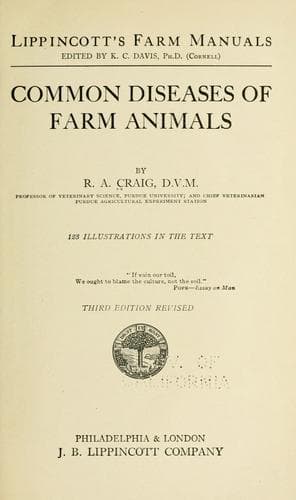
Common Diseases of Farm AnimalsCraig, Robert Alexander
Science
Common Diseases of Farm Animals
Craig, Robert Alexander
Veterinary medicine
We may class muscles as _striated_ or _voluntary_ and _unstriated_ or
_involuntary._ A third class, _mixed,_ is represented by the heart muscle.
The striated is represented by the skeletal muscles, and the unstriated by
the thin muscular layers that form part of the wall of the stomach,
intestines, bladder and other hollow organs.
RHEUMATISM.--This is an inflammation of the tissues that form the
locomotory apparatus. The effect of cold on the muscles and tendons is an
important factor in its production. It differs from other inflammations by
shifting from one part to another. It is termed _muscular rheumatism_ when
it affects the muscles, tendons and fascia, and _articular rheumatism_ when
it involves the articulations. A second classification, _acute_ and
_chronic,_ depends on the character of the inflammation. The muscular form
is common in horses, dogs and hogs, while the articular form more commonly
affects cattle.
_The following causes_ may be considered. Animals that are exposed to cold,
wet, changeable weather, or kept in cold, damp, draughty quarters
frequently suffer from rheumatism. Under such conditions it is very
probable that imperfect metabolism of body tissue occurs, and certain toxic
products that are capable of irritating the muscles and articulations form.
Clinical symptoms, and the presence of bacteria in the inflamed tissue
indicate that bacteria and their toxins play an important part in the
development of articular rheumatism. Heredity is said to be an important
predisposing factor. One attack always predisposes the animal to a second.
_The symptoms vary_ according to the severity of the attack. Local
rheumatism is not accompanied by serious symptoms. The regions most
commonly involved in local, muscular rheumatism are the shoulder, neck and
back. The joints affected in the articular form are the knee, fetlock, hip,
elbow and shoulder. The attack is usually sudden and accompanied by fever,
more or less loss of appetite and soreness. Loss of control over the
movement of the hind parts or walking on the knees may occur in the smaller
animals. The larger animals show a slight or severe lameness. The affected
muscle or articulation may be swollen, hot and tender. Pressing on the part
with the hand or forcing the animal to move about may cause severe pain.
Weakness and emaciation may occur in generalized and articular rheumatism,
especially if suppuration takes place in the affected joint.
_The prognosis_ is more favorable in muscular rheumatism than in the
articular form. Both forms may become chronic. It is frequently advisable
to destroy animals suffering from the articular form because of their
emaciated, weakened condition and the deformed condition of the joints.
Public-domain text, read in full here on John Shaqi.
Reviews
Reviews
No reviews yet
Be the first to share your thoughts on this work.
Elsewhere in the archive
Join the Discussion
Join the discussion
Sign in to leave a comment or review.
Sign InorCreate an account