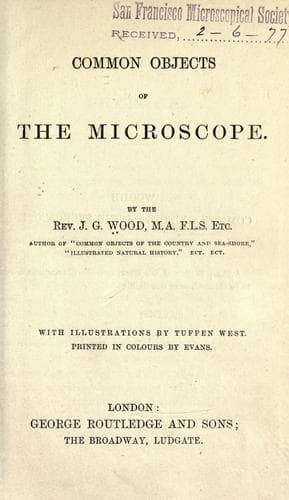
Common objects of the microscopeWood, J. G. (John George)
Science
Common objects of the microscope
Wood, J. G. (John George)
Microscopes; Microscopy
FIG.
1. Rose Leaf, with fungus
2. Moss capsule, Polytrichum
3. Jungermannia, capsule
4. Do. an elater more magnified
5. Leaf of Moss, Sphagnum
6. Rootlet, Moss
7. Puccinia, from Thistle
8. Jungermannia, leaf
9. Scale from stalk of male fern
10. Uredo
11. Sphacelaria filicina
12. Do. top, more magnified
13. Seaweed, showing fruit
14. Do. fruit, more magnified
15. Ceramium
16. Capsule, Halidrys
17. Spore of do.
18. Polysiphonia parasitica
19. Do. stem, more magnified
20. Do. Capsule, tetraspores escaping
21. Do. fruit, another form
22. Ceramium, fruit
23. Myrionema, parasitic Seaweed
24. Delesseria sanguinea, Frond
25. Cladophora
26. Ptilota elegans
27. Enteromorpha clathrata
28. Nitophyllum laceratum
[Illustration: V.]
The figure on the bottom left-hand corner of Plate V. is a portion of
the pretty Nitophyllum lacerátum, a plant belonging to the same family
as the preceding one. The specimen here represented has a gathering
of spores upon the frond, in which state the frond is said to be “in
fruit.”
Fig. 27 represents a portion of the common sea-grass (_Enteromorpha_),
so common on rocks and stones between the range of high and low water.
On the left hand of the figure, and near the top, is a small piece of
the same plant much more magnified, in order to show the form of its
cells.
CHAPTER VII
Antennæ, their Structure and Use--Eyes, Compound and
Simple--Breathing Organs--Jaws and their Appendages--Legs, Feet,
and Suckers--Digestive Organs--Wings, Scales, and Hairs--Eggs
of Insects--Hair, Wool, Linen, Silk, and Cotton--Scales of
Fish--Feathers--Skin and its Structure--Epithelium--Nails, Bone, and
Teeth--Blood Corpuscles and Circulation--Elastic Tissues--Muscle and
Nerve.
We now take leave of the vegetables for a time, and turn our attention
to the animal kingdom.
On Plate VI. may be seen many beautiful examples of animal structures,
most of them being taken from the insect tribes. We will begin with the
antennæ, or horns, as they are popularly termed, of the insect.
The forms of these organs are as varied as those of the insects to
which they belong, and they are so well defined that a single antenna
will, in almost every instance, enable a good entomologist to designate
the genus to which the insect belonged. The functions of the antennæ
are not satisfactorily ascertained. They are certainly often used as
organs of speech, as may be seen when two ants meet each other, cross
their antennæ, and then start off simultaneously to some task which is
too much for a single ant. This pretty scene may be witnessed on any
fine day in a wood, and a very animated series of conversations may
readily be elicited by laying a stick across their paths, or putting a
dead mouse or large insect in their way.
Public-domain text, read in full here on John Shaqi.
Reviews
Reviews
No reviews yet
Be the first to share your thoughts on this work.
Join the Discussion
Join the discussion
Sign in to leave a comment or review.
Sign InorCreate an account