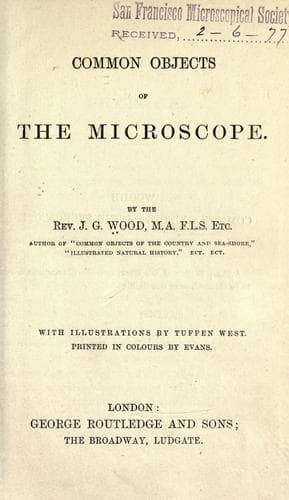
Common objects of the microscopeWood, J. G. (John George)
Science
Common objects of the microscope
Wood, J. G. (John George)
Microscopes; Microscopy
The corpuscles go pushing and jostling one another in the oddest
fashion, just like a British crowd entering an exhibition, each one
seeming to be elbowing its way to the best place. To see them turning
the corners is very amusing, for they always seem as if they never
could get round the smaller vessels, and yet invariably accomplish the
task with perfect ease, turning about and steering themselves as if
possessed of volition, and insinuating their ends when they could not
pass crosswise.
By putting various substances, such as spirit or salt, upon the
foot, the rapidity of the circulation at the spot can be greatly
increased or reduced at will, or even stopped altogether for a while,
and the phenomenon of inflammation and its gradual natural cure be
beautifully illustrated. The numerous black spots upon the surface are
pigment-cells.
The tails of young fish also afford excellent objects under the
microscope, as the circulation can be seen nearly as well as in the
frog’s foot. The gills of tadpoles can also be arranged upon the stage
with a little care, and the same organs in the young of the common newt
will also exhibit the circulation in a favourable manner. The frog,
however, is perhaps the best, as it can be arranged on the “frog-plate”
without difficulty, and the creature may be kept for months by placing
it in a cool, damp spot, and feeding it with flies, little slugs, and
similar creatures.
CHAPTER VIII
Pond-Life--Apparatus and Instructions for Collecting Objects--Methods
of Examination--Sponge--Infusoria.
Of all departments of microscopic research the most fascinating and
the most popular is that which deals with what is known by the generic
name of “pond-life.” The minute forms of the animal creation included
in this term are of such exquisite beauty, and allow the processes of
their life-history to be followed with such facility, from the cradle
(when they have one) to the grave (which is very often the body of
another, larger, organism), that there is none which has attracted
more observers. Indeed, the first application of the microscope, by
Leeuwenhoek, early in the seventeenth century, was to the observation
of these forms of life.
X.
Public-domain text, read in full here on John Shaqi.
Reviews
Reviews
No reviews yet
Be the first to share your thoughts on this work.
Elsewhere in the archive
Join the Discussion
Join the discussion
Sign in to leave a comment or review.
Sign InorCreate an account