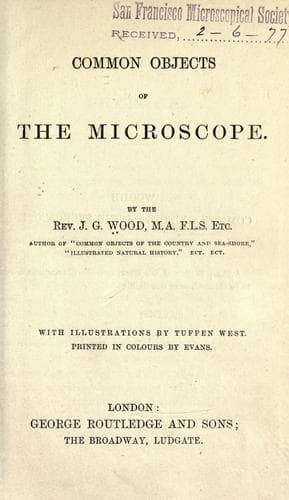
Common objects of the microscopeWood, J. G. (John George)
Science
Common objects of the microscope
Wood, J. G. (John George)
Microscopes; Microscopy
For examination a glass trough of considerable size, say three inches
in length, half an inch in depth, and two inches in height, should be
half filled with the water, and examined with the pocket magnifier.
With a little practice it will be found easy to take up not only
the larger organisms, but even very minute ones, with one of the
dipping-tubes with a long tapering point already referred to. The
organism, when “spotted,” is followed by eye and tube, the finger
being held over the mouth of the latter, and at the critical moment
the finger is removed, and the organism swept into the tube by the
in-rushing water. Now wipe off the excess with a clean handkerchief,
“spot” the organism in the tube again, and carefully absorb the
superfluous water with a piece of blotting paper; and finally, gently
but sharply blow the remainder on to the plate of the live-box, put on
the cover, and examine with a one-inch power. If, as often happens,
the organism sticks to the side of the tube, a little more water must
be drawn in, and the process repeated. The use of the cotton-wool trap
spoken of previously will often be very helpful in the examination of
actively moving organisms.
In the case of weeds, a small portion should be placed in the trough
and carefully examined from end to end, first with the pocket lens and
then with the one-inch power. Let us now consider the objects most
likely to be met with.
A piece of stick may be coated with a white layer, feeling rough to the
touch, and full of small holes. The chances are that this will be a
piece of fresh-water sponge, _Spongilla fluviatílis_, and by dark-field
illumination particles may be seen to enter at some orifices and be
ejected at others. With a very high power and a very thin section,
properly prepared, these holes will be seen to be the mouths of
channels which are lined by the most delicate organisms possible, each
having a minute body crowned with a tiny crystal cup, in the middle of
which is a long cilium, or flagellum, as it is here called (Plate XIII.
Fig. 1). The currents are produced by the combined action of these
flagella. In point of fact, the sponge is a colony of minute animals
working harmoniously for the common good. If the specimen be found in
winter the sponge will be full of tiny balls, the “gemmules” of the
next season’s growth. The roughness is due to the flinty spicules,
which are at once the scaffolding and the protection of the sponge, and
by boiling the sponge in a mixture of nitric acid and water (half and
half) these spicules will be set free, and may be washed, allowed to
settle, washed again, dried, and mounted in balsam. The gemmules are
coated by very beautiful spicules, consisting of two wheels connected
by a rod. These may be treated in the same way. The life-history of the
common sponge is as yet but imperfectly known.
Public-domain text, read in full here on John Shaqi.
Reviews
Reviews
No reviews yet
Be the first to share your thoughts on this work.
Elsewhere in the archive
Join the Discussion
Join the discussion
Sign in to leave a comment or review.
Sign InorCreate an account