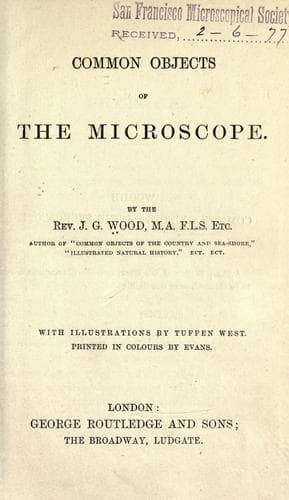
Common objects of the microscopeWood, J. G. (John George)
Science
Common objects of the microscope
Wood, J. G. (John George)
Microscopes; Microscopy
Some similar organisms may, nevertheless, be found which, though
still minute, are within the range of a properly managed quarter-inch
objective. Such an one, of extreme beauty, is the _Dinobrýon_ shown in
Plate XIII. Fig. 3. Each “zoöid,” as the separate animals are called,
among the Infusoria, or each generation of zoöids, stands upon its
parent and has two flagella. When alarmed, the zoöid sinks to the
bottom of its cell, and withdraws its flagella. In Fig. 2 (_Eugléna_)
we have a similar zoöid, but of far greater size, and free-swimming.
It is a very common object, and possesses a red eye-speck close to the
“contractile vesicle.” All Infusoria have the latter, some a great
number, as in Fig. 9. The vesicle contracts at regular intervals, and
is then simply blotted out, but reforms in the same place, so that it
is probably the heart or the urinary bladder of these minute animals.
The lovely rosette shown in Fig. 4 is the _Synura_, a spherical colony
of zoöids, each of which has two flagella, and is in addition clothed
with rows of cilia. A beautiful sight it is to watch these colonies
rolling through the field of view. Not uncommon, especially in brackish
water, is the _Peridinium_ (Fig. 5), with its plate armour, long
flagellum, and girdle of cilia. A gigantic species of the same family
is common in sea-water, and will be easily recognised by its body, not
much larger than that of Peridinium, being furnished with three long
arms, curiously bent. It is called _Ceratium_, and is sometimes present
in such abundance as to thicken the water, near the surface of which it
swims.
We now come to a class of Infusoria which is characterised by the
possession of a complete covering of cilia, arranged in rows all over
the body. The number of these is enormous; we can only glance at a
few types, by mastering which the observer will, at all events, know
whereabouts he is. The first we will take is the _Coleps_ (Fig. 6),
a very common kind, whose body is marked by a series of geometrical
lines, so that the organism looks very much like an elongated
geographical globe. These markings are on the tunic, which is of a
brownish colour. Very different is the _Trachelocerca_ (Fig. 7), with
its long flexible neck, which is in constant movement from side to side
as the creature swims along. As seen in the figure, the neck is clear
and the head has a fringe of longer cilia.
Public-domain text, read in full here on John Shaqi.
Reviews
Reviews
No reviews yet
Be the first to share your thoughts on this work.
Elsewhere in the archive
Join the Discussion
Join the discussion
Sign in to leave a comment or review.
Sign InorCreate an account