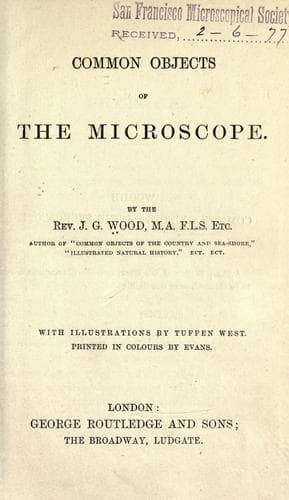
Common objects of the microscopeWood, J. G. (John George)
Science
Common objects of the microscope
Wood, J. G. (John George)
Microscopes; Microscopy
One large group has the peculiarity of multiplying by division, the
last joints or segments being devoted to the formation of the new
individual. At one time of the year the ordinary sexual process of
reproduction takes the place of this method, and each worm is then
surrounded by a belt such as may be seen in the common earthworm under
similar conditions. Further information on this subject is greatly
needed.
The type is the common _Naïs_, which has a body of thirty segments or
more, two eye-specks on the head, and a double row of bristles along
the back; whilst below, each segment carries strong hooked bristles,
nearly buried in the body, by means of which the worm crawls. Inside
the mouth is a large proboscis, which can be protruded, and this leads
into a stomach which is merely an enlargement of the intestine which
succeeds it. The circulation of the blood (which is colourless) can be
easily watched. It begins at the tail with a contraction of the dorsal
vessel, passes up to the head, and then down below the intestine to the
tail again. The intestine is ciliated inside, and it is by a current
of water carried into the intestine by these cilia that the blood is
aërated.
In the next genus, _Dero_, this is clearly seen, for the tail (Plate
XIV. Fig. 1) is opened out into a wide shield, from which rise four,
six, or even eight finger-like processes. These parts are all ciliated,
and contain a network of blood-vessels. The worm lives in a case which
it builds in the mud, and the way to find it is to put some of the mud
into a glass beaker with water, and allow it to stand. If there be
members of this family in it, their tails will be seen protruding above
the water. Pour out the mud sharply, fill up with water, and allow the
dirt to subside, and the worms may then be made to leave their cases by
pressure by a camel hair pencil on the lower end of the tube, and may
be caught with the dipping tube and placed in the live-box. They have
no eyes, otherwise the general outline of the body closely resembles
that of Naïs.
_Slavína_ (Fig. 2) has a row of touch-organs, like pimples, round
each segment, and is a dirty looking creature, with an inordinately
long first pair of bristles, but this reaches its acme in _Pristina_
(Fig. 3) (sometimes, though wrongly, called _Stylaria_) _parasita_,
which has three long sets of bristles upon the back, and keeps these in
constant wing-like motion. The true _Stylaria_ has a long trunk, set
right in the head, and tubular (Fig. 6); it grows to a considerable
length, and when in the stage of fission it is very funny to see
the two proboscides waving about, one on the middle, as well as the
original one at the head. There is also a form with a shorter proboscis
of the same kind.
Public-domain text, read in full here on John Shaqi.
Reviews
Reviews
No reviews yet
Be the first to share your thoughts on this work.
Elsewhere in the archive
Join the Discussion
Join the discussion
Sign in to leave a comment or review.
Sign InorCreate an account