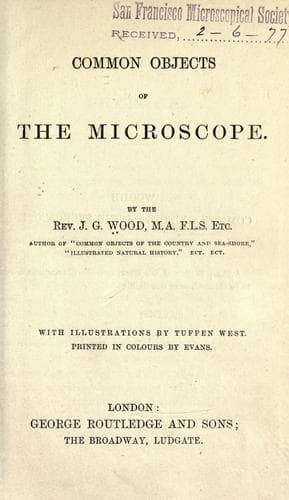
Common objects of the microscopeWood, J. G. (John George)
Science
Common objects of the microscope
Wood, J. G. (John George)
Microscopes; Microscopy
The structure of shell, _e.g._ oyster-shell, is well shown in three
examples: Fig. 34 is a group of artificial crystals of carbonate of
lime; and on Figs. 38 and 39 may be seen part of an oyster-shell,
showing how it is composed of similar crystals aggregated together.
Their appearance under polarised light may be seen on Plate XI. Figs. 1
and 6.
We now pass on to the Echinoderms, including the star-fishes and
sea-urchins.
The old story of the goose-bearing tree is an example of how truth may
be stranger than fiction. For if the fable had said that the mother
goose laid eggs which grew into trees, budded and flowered, and then
produced new geese, it would not have been one whit a stranger tale
than the truth. Plate IX. Fig. 33, shows the young state of one of
the common star-fishes (_Comátula_), which in its early days is like
a plant with a stalk, but afterwards breaks loose and becomes the
wandering sea-star which we all know so well. In this process there
is just the reverse of that which characterises the barnacles and
sponges, where the young are at first free and then become fixed for
the remainder of their lives. Fig. 30 is the young of another kind of
star-fish, the long-armed Ophiúris, or snake-star.
Fig. 37 is a portion of the skin of the common sun-star (_Solaster_),
showing the single large spine surrounded by a circle of smaller
spines, supposed to be organs of touch, together with two or three
of the curious appendages called pedicellariæ. These are found on
star-fishes and Echini, and bear a close resemblance in many respects
to the bird-head appendages of the zoophytes. They are fixed on
foot-stalks, some very long and others very short, and have jaws which
open and shut regularly. Their use is doubtful, unless it be to act as
police, and by their continual movements to prevent the spores of algæ,
or the young of various marine animals, from effecting a lodgment on
the skin. A group, of pedicellariæ from a star-fish is shown on a large
scale on Plate XII. Fig. 6, and Fig. 9 of the same Plate shows the
pedicellariæ of the Echinus.
Upon the exterior of the Echini, or sea-urchins, are a vast number of
spines having a very beautiful structure, as may be seen by Fig. 35,
Plate IX., which is part of a transverse section of one of these
spines. An entire spine is shown on Plate XII. Fig. 12, and shows the
ball-and-socket joint on which it moves, and the membranous muscle that
moves it. Fig. 8 is the disc of the snake-star as seen from below.
Fig. 1 is a portion of skin of the sun-star, to show one of the curious
madrepore-like tubercles which are found upon this common star-fish.
Fig. 3 is a portion of cuttle “bone,” very slightly magnified, in order
to show the beautiful pillar-like form of its structure; and Fig. 4
is the same object seen from above. When ground very thin this is a
magnificent object for the polariscope.
Public-domain text, read in full here on John Shaqi.
Reviews
Reviews
No reviews yet
Be the first to share your thoughts on this work.
Elsewhere in the archive
Join the Discussion
Join the discussion
Sign in to leave a comment or review.
Sign InorCreate an account