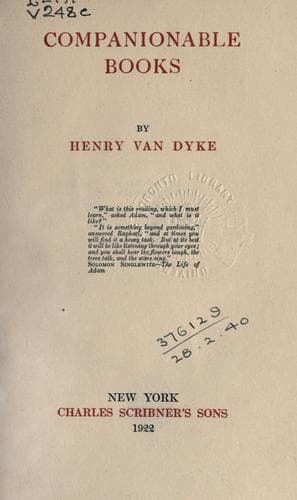
English literature -- History and criticism; Literature -- History and criticism
His _Threnody_, written after the early death of his first-born son, has
always seemed to me one of the most moving elegies in the English tongue.
His patriotic poems, especially the _Concord Ode_, are unsurpassed as
brief, lyrical utterances of the spirit of America. In certain moods,
when the mind is in vigour and the windows of far vision open at a touch,
Emerson’s small volume of _Poems_ is a most companionable book.
* * * * *
As his prose sometimes intrudes into his verse and checks its flow, so
his poetry often runs over into his prose and illuminates it. What could
be more poetic in conception than this sentence from his first book,
_Nature_? “If the stars should appear but one night in a thousand years,
how would men believe and adore and preserve for many generations the
remembrance of the city of God which had been shown!”
Emerson’s _Essays_ are a distillation of his lectures. His way of making
these was singular and all his own. It was his habit to keep note-books
in which he jotted down bits of observation about nature, stray thoughts
and comparisons, reflections on his reading, and striking phrases which
came to him in meditation or talk. Choosing a subject he planted it in
his mind and waited for ideas and illustrations to come to it, as birds
or insects to a flower. When a thought appeared he followed it, “as a
boy might hunt a butterfly,” and when it was captured he pinned it in
his “thought-book.” No doubt there were mental laws at work all the
time, giving guidance and direction to the process of composition which
seemed so irregular and haphazard. There is no lack of vital unity in
one of Emerson’s lectures or essays. It deals with a single subject and
never gets really out of sight of the proposition with which it begins.
Yet it seldom gives a complete, all-round view of it. It is more like a
series of swift and vivid glimpses of the same object seen from different
stand-points, a collection of snap-shot pictures taken in the course of a
walk around some great mountain.
From the pages of his note-books he gathered the material for one of
his lectures, selecting and arranging it under some such title as Fate,
Genius, Beauty, Manners, Duty, The Anglo-Saxon, The Young American,
and giving it such form and order as he thought would be most effective
in delivery. If the lecture was often repeated, (as it usually was,)
the material was frequently rearranged, the pages were shifted, the
illustrations changed. Then, after it had served its purpose, the
material was again rearranged and published in a volume of _Essays_.
Public-domain text, read in full here on John Shaqi.
Reviews
Reviews
No reviews yet
Be the first to share your thoughts on this work.
Elsewhere in the archive
Join the Discussion
Join the discussion
Sign in to leave a comment or review.
Sign InorCreate an account