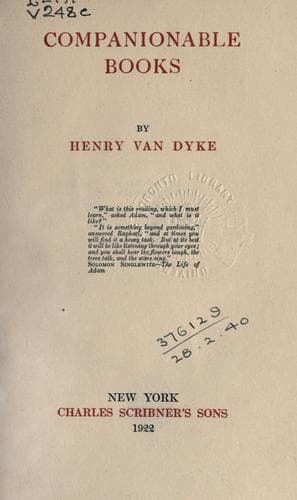
English literature -- History and criticism; Literature -- History and criticism
Stevenson describes (as far as such a thing is possible) the way in which
he got his style. “All through my boyhood and youth,” says he, “I was
known and pointed out for the pattern of an idler, and yet I was always
busy on my own private end, which was to learn to write.” He traces
with gusto, and doubtless with as much accuracy as can be expected in a
map drawn from memory, the trails of early admiration which he followed
towards this goal. His list of “authors whom I have imitated” is most
entertaining: Hazlitt, Lamb, Wordsworth, Sir Thomas Browne, Defoe,
Hawthorne, Montaigne, Baudelaire, Obermann. In another essay, on “Books
Which Have Influenced Me,” he names _The Bible_, _Hamlet_, _As You Like
It_, _King Lear_, _Le Vicomte de Bragelonne_, _The Pilgrim’s Progress_,
_Leaves of Grass_, Herbert Spencer’s books, Lewes’s _Life of Goethe_,
the _Meditations_ of Marcus Aurelius, the poems of Wordsworth, George
Meredith’s _The Egoist_, the essays of Thoreau and Hazlitt, Mitford’s
_Tales of Old Japan_,—a strange catalogue, but not incoherent if you
remember that he is speaking now more of their effect upon his way of
thinking than of their guidance in his manner of writing,—though in this
also I reckon he learned something from them, especially from the English
Bible.
Besides the books which he read, he carried about with him little
blank-books in which he jotted down the noteworthy in what he saw, heard,
or imagined. He learned also from penless authors, composers without a
manuscript, masters of the _viva-voce_ style, like Robert, the Scotch
gardener, and John Todd, the shepherd. When he saw a beggar on horseback,
he cared not where the horse came from, he watched the rascal ride.
If an expression struck him “for some conspicuous force, some happy
distinction,” he promptly annexed it;—because he understood it, it was
his.
In two separate essays, each of which he calls “A Gossip,” he pays
tribute to “the bracing influence of old Dumas,” and to the sweeping
power and broad charm of Walter Scott, “a great romantic—an idle child,”
the type of easy writers. But Stevenson is of a totally different type,
though of a kindred spirit. He is the best example in modern English of
a careful writer. He modelled and remodelled, touched and retouched his
work, toiled tremendously. The chapter on Honolulu in _The Wrecker_, was
rewritten ten times. His essays for _Scribner’s Magazine_ passed through
half a dozen revisions.
Public-domain text, read in full here on John Shaqi.
Reviews
Reviews
No reviews yet
Be the first to share your thoughts on this work.
Elsewhere in the archive
Join the Discussion
Join the discussion
Sign in to leave a comment or review.
Sign InorCreate an account