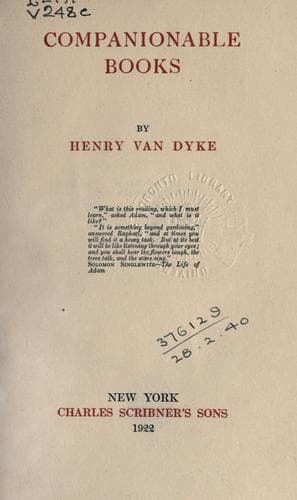
English literature -- History and criticism; Literature -- History and criticism
There is no “besotting particularity” in such details as these. On the
contrary they illustrate the classic conception of a work of art, in
which every particular must be vitally connected with the general, and
the perfection of the smallest part depends upon its relation to the
perfect whole. Now this is precisely the quality, and the charm, of
Stevenson’s stories, short or long. He omits the non-essential, but his
eye never misses the significant. He does not waste your time and his
own in describing the coloured lights in the window of a chemist’s shop
where nothing is to happen, or the quaint costume of a disagreeable
woman who has no real part in the story. That kind of realism, of local
colour, does not interest him. But he is careful to let you know that
Alan Breck wore a sword that was much too long for him; that Mr. Hyde
was pale and dwarfish, gave an impression of deformity without any
nameable malformation, and bore himself “with a sort of murderous mixture
of timidity and boldness”; that John Silver could use his wooden leg as
a terrible weapon; that the kitchen of the cottage on Aros was crammed
with rare incongruous treasures from far away; and that on a certain
cold sunny morning “the blackbirds sung exceeding sweet and loud about
the House of Durisdeer, and there was a noise of the sea in all the
chambers.” Why these _trivia_? Why such an exact touch on these details?
Because they count.
Yet Stevenson’s tales and romances do not give—at least to me—the effect
of over-elaboration, of strain, of conscious effort; there is nothing
affected and therefore nothing tedious in them. They move; they carry you
along with them; they are easy to read; one does not wish to lay them
down and take a rest. There is artifice in them, of course, but it is
a thoroughly natural artifice,—as natural as a clean voice and a clear
enunciation are to a well-bred gentleman. He does not think about them;
he uses them in his habit as he lives. Tusitala enjoys his work as a
teller of tales; he is at home in it. His manner is his own; it suits
him; he wears it without fear or misgiving,—the velvet jacket again.
III
Public-domain text, read in full here on John Shaqi.
Reviews
Reviews
No reviews yet
Be the first to share your thoughts on this work.
Elsewhere in the archive
Join the Discussion
Join the discussion
Sign in to leave a comment or review.
Sign InorCreate an account