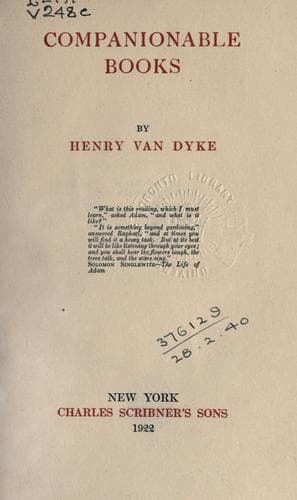
English literature -- History and criticism; Literature -- History and criticism
This is the point of view from which Stevenson writes as a novelist;
you can feel it even in a romance as romantic as _Prince Otto_; and in
his essays, where he speaks directly and in the first person, this way
of taking life as an adventure for the valourous and faithful comes out
yet more distinctly. The grace and vigour of his diction, the pointed
quality of his style, the wit of his comment on men and books, add to the
persuasiveness of his teaching. I can see no reason why morality should
be drab and dull. It was not so in Stevenson’s character, nor is it so
in his books. That is one reason why they are companionable.
“There is nothing in it [the world],” wrote he to a friend, “but the
moral side—but the great battle and the breathing times with their
refreshments. I see no more and no less. And if you look again, it is not
ugly, and it is filled with promise.”
FOOTNOTES
[1] _Syllabus Scriptorum Veterum Recentiumque qui Veritatem Religionis
Christianæ Asseruerunt_: Hamburg, 1725.
[2] _The Poetry of Tennyson._ Scribner’s: New York, 1889-1920.
[3] Smith, Elder & Co.: London, 1880.
[4] _The Bible in Browning._ Macmillan: New York, 1903.
[5] “The Works of Mr. Abraham Cowley.” London, 1710. Preface to
_Pindarique Odes_, volume I, page 184.
[6] Lowth, _De Sacra Poesi Hebræorum Praelectiones_. Oxon., 1753.
[7] _English Odes_, selected by Edmund Gosse. Preface, page xiii.
[8] _The Book of Psalms._ 2 volumes, London, 1883. Volume I, page 82.
[9] Joseph Addison, 1712.
[10] Reverend A. H. Strong, _The Great Poets and their Theology_, p. 384.
[11] John Jay Chapman, _Emerson and Other Essays_, p. 195.
[12] J. H. Nettleship, _Robert Browning, Essays and Thoughts_, p. 292.
[13] Miss Vida D. Scudder, _The Life of the Spirit in Modern English
Poets_.
[14] Epilogue to _Dramatis Personæ_.
[15] Cheney, _The Golden Guess_, p. 143.
[16] _Memoir of Alfred Lord Tennyson_, vol. II, p. 230.
[17] _Asolando_, “Reverie.”
[18] J. J. Chapman, _Emerson, and Other Essays_.
[19] I am haunted by the notion that Johnson himself said this, but I
cannot find the passage for quotation.
End of the Project Gutenberg EBook of Companionable Books, by Henry van Dyke
Public-domain text, read in full here on John Shaqi.
Reviews
Reviews
No reviews yet
Be the first to share your thoughts on this work.
Elsewhere in the archive
Join the Discussion
Join the discussion
Sign in to leave a comment or review.
Sign InorCreate an account