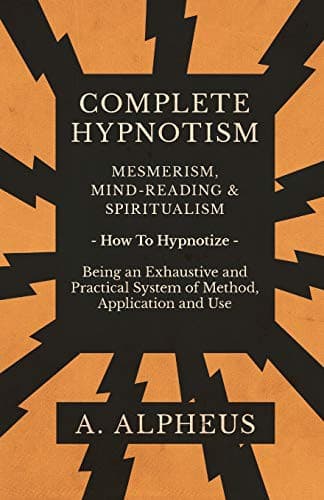
Complete Hypnotism, Mesmerism, Mind-Reading and Spiritualism: How to Hypnotize: Being an Exhaustive and Practical System of Method, Application, and UseAlpheus, A.
History
Complete Hypnotism, Mesmerism, Mind-Reading and Spiritualism: How to Hypnotize: Being an Exhaustive and Practical System of Method, Application, and Use
Alpheus, A.
Hypnotism; Mesmerism; Spiritualism; Telepathy
Hallucination.—“Hallucinations,” says a medical authority, “are very
common among those who are partially insane. They occur as a result of
fever and frequently accompany delirium. They result from an
impoverished condition of the blood, especially if it is due to
starvation, indigestion, and the use of drugs like belladonna,
hyoscyarnus, stramonium, opium, chloral, cannabis indica, and many more
that might be mentioned.”
Large numbers of cases of attempted cure by hypnotism, successful and
unsuccessful, might be quoted. There is no doubt that in the lighter
forms of partial insanity, hypnotism may help many patients, though not
all; but when the disease of the brain has gone farther, especially
when a well developed lesion exists in the brain, mental treatment is
of little avail, even if it can be practiced at all.
A few general remarks by Dr. Bernheim will be interesting. Says he:
“The mode of suggestion should be varied and adapted to the special
suggestibility of the subject. A simple word does not always suffice in
impressing the idea upon the mind. It is sometimes necessary to reason,
to prove, to convince; in some cases to affirm decidedly, in others to
insinuate gently; for in the condition of sleep, just as in the waking
condition, the moral individuality of each subject persists according
to his character, his inclinations, his impressionability, etc.
Hypnosis does not run all subjects into a uniform mold, and make pure
and simple automatons out of them, moved solely by the will of the
hypnotist; it increases cerebral docility; it makes the automatic
activity preponderate over the will. But the latter persists to a
certain degree; the subject thinks, reasons, discusses, accepts more
readily than in the waking condition, but does not always accept,
especially in the light degrees of sleep. In these cases we must know
the patient’s character, his particular psychical condition, in order
to make an impression upon him.”
Bad Habits.—The habit of the excessive use of alcoholic drinks,
morphine, tobacco, or the like, may often be decidedly helped by
hypnotism, if the patient wants to be helped. The method of operation
is simple. The operator hypnotizes the subject, and when he is in deep
sleep suggests that on awaking he will feel a deep disgust for the
article he is in the habit of taking, and if he takes it will be
affected by nausea, or other unpleasant symptoms. In most cases the
suggested result takes place, provided the subject can be hypnotized al
all; but unless the patient is himself anxious to break the habit fixed
upon him, the unpleasant effects soon wear off and he is as bad as
ever.
Public-domain text, read in full here on John Shaqi.
Reviews
Reviews
No reviews yet
Be the first to share your thoughts on this work.
Elsewhere in the archive
Join the Discussion
Join the discussion
Sign in to leave a comment or review.
Sign InorCreate an account