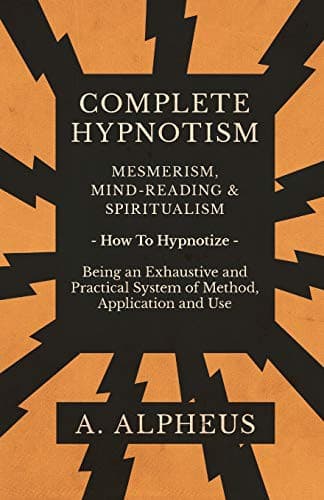
Complete Hypnotism, Mesmerism, Mind-Reading and Spiritualism: How to Hypnotize: Being an Exhaustive and Practical System of Method, Application, and UseAlpheus, A.
History
Complete Hypnotism, Mesmerism, Mind-Reading and Spiritualism: How to Hypnotize: Being an Exhaustive and Practical System of Method, Application, and Use
Alpheus, A.
Hypnotism; Mesmerism; Spiritualism; Telepathy
Dr. Cocke treated a large number of cases, which he reports in detail
in his book on hypnotism. In a fair proportion of the cases he was
successful; in some cases completely so. In other cases he failed
entirely, owing to lack of moral stamina in the patient himself. His
conclusions seem to be that hypnotism may be made a very effective aid
to moral suasion, but after all, character is the chief force which
throws off such habits once they are fixed. The morphine habit is
usually the result of a doctor’s prescription at some time, and it is
practiced more or less involuntarily. Such cases are often materially
helped by the proper suggestions.
The same is true of bad habits in children. The weak may be
strengthened by the stronger nature, and hypnotism may come in as an
effective aid to moral influence. Here again character is the deciding
factor.
Dr. James R. Cocke devotes a considerable part of his book on
“Hypnotism” to the use of hypnotism in medical practice, and for
further interesting details the reader is referred to that able work.
CHAPTER X.
Hypnotism of Animals.—Snake Charming.
We are all familiar with the snake charmer, and the charming of birds
by snakes. How much hypnotism there is in these performances it would
be hard to say. It is probable that a bird is fascinated to some extent
by the steady gaze of a serpent’s eyes, but fear will certainly
paralyze a bird as effectively as hypnotism.
Father Kircher was the first to try a familiar experiment with hens and
cocks. If you hold a hen’s head with the beak upon a piece of board,
and then draw a chalk line from the beak to the edge of the board, the
hen when released will continue to hold her head in the same position
for some time, finally walking slowly away, as if roused from a stupor.
Farmers’ wives often try a sort of hypnotic experiment on hens they
wish to transfer from one nest to another when sitting. They put the
hen’s head under her wing and gently rock her to and fro till she
apparently goes to sleep, when she may be carried to another nest and
will remain there afterward.
Horses are frequently managed by a steady gaze into their eyes. Dr.
Moll states that a method of hypnotizing horses named after its
inventor as Balassiren has been introduced into Austria by law for the
shoeing of horses in the army.
We have all heard of the snake charmers of India, who make the snakes
imitate all their movements. Some suppose this is by hypnotization. It
may be the result of training, however. Certainly real charmers of wild
beasts usually end by being bitten or injured in some other way, which
would seem to show that the hypnotization does not always work, or else
it does not exist at all.
We have some fairly well known instances of hypnotism produced in
animals. Lafontaine, the magnetizer, some thirty years ago held public
exhibitions in Paris in which he reduced cats, dogs, squirrels and
lions to such complete insensibility that they felt neither pricks nor
blows.
Public-domain text, read in full here on John Shaqi.
Reviews
Reviews
No reviews yet
Be the first to share your thoughts on this work.
Elsewhere in the archive
Join the Discussion
Join the discussion
Sign in to leave a comment or review.
Sign InorCreate an account