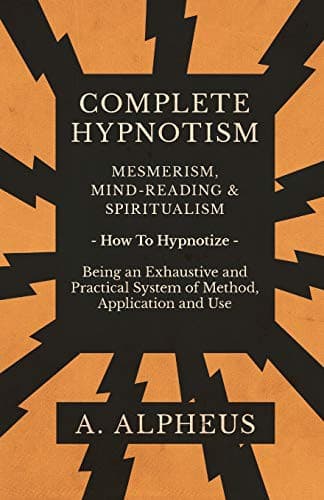
Complete Hypnotism, Mesmerism, Mind-Reading and Spiritualism: How to Hypnotize: Being an Exhaustive and Practical System of Method, Application, and UseAlpheus, A.
History
Complete Hypnotism, Mesmerism, Mind-Reading and Spiritualism: How to Hypnotize: Being an Exhaustive and Practical System of Method, Application, and Use
Alpheus, A.
Hypnotism; Mesmerism; Spiritualism; Telepathy
The Harvys or Psylles of Egypt impart to the ringed snake the
appearance of a stick by pressure on the head, which induces a species
of tetanus, says E. W. Lane.
The following description of serpent charming by the Aissouans of the
province of Sous, Morocco, will be of interest:
“The principal charmer began by whirling with astonishing rapidity in a
kind of frenzied dance around the wicker basket that contained the
serpents, which were covered by a goatskin. Suddenly he stopped,
plunged his naked arm into the basket, and drew out a cobra de capello,
or else a haje, a fearful reptile which is able to swell its head by
spreading out the scales which cover it, and which is thought to be
Cleopatra’s asp, the serpent of Egypt. In Morocco it is known as the
buska. The charmer folded and unfolded the greenish-black viper, as if
it were a piece of muslin; he rolled it like a turban round his head,
and continued his dance while the serpent maintained its position, and
seemed to follow every movement and wish of the dancer.
“The buska was then placed on the ground, and raising itself straight
on end, in the attitude it assumes on desert roads to attract
travelers, began to sway from right to left, following the rhythm of
the music. The Aissoua, whirling more and more rapidly in constantly
narrowing circles, plunged his hand once more into the basket, and
pulled out two of the most venomous reptiles of the desert of Sous;
serpents thicker than a man’s arm, two or three feet long, whose
shining scales are spotted black or yellow, and whose bite sends, as it
were, a burning fire through the veins. This reptile is probably the
torrida dipsas of antiquity. Europeans now call it the leffah.
“The two leffahs, more vigorous and less docile than the buska, lay
half curled up, their heads on one side, ready to dart forward, and
followed with glittering eyes the movements of the dancer. * * * Hindoo
charmers are still more wonderful; they juggle with a dozen different
species of reptiles at the same time, making them come and go, leap,
dance, and lie down at the sound of the charmer’s whistle, like the
gentlest of tame animals. These serpents have never been known to bite
their charmers.”
It is well known that some animals, like the opossum, feign death when
caught. Whether this is to be compared to hypnotism is doubtful. Other
animals, called hibernating, sleep for months with no other food than
their fat, but this, again, can hardly be called hypnotism.
CHAPTER XI.
A Scientific Explanation of Hypnotism.—Dr. Hart’s Theory.
In the introduction to this book the reader will find a summary of the
theories of hypnotism. There is no doubt that hypnotism is a complex
state which cannot be explained in an offhand way in a sentence or two.
There are, however, certain aspects of hypnotism which we may suppose
sufficiently explained by certain scientific writers on the subject.
Public-domain text, read in full here on John Shaqi.
Reviews
Reviews
No reviews yet
Be the first to share your thoughts on this work.
Elsewhere in the archive
Join the Discussion
Join the discussion
Sign in to leave a comment or review.
Sign InorCreate an account