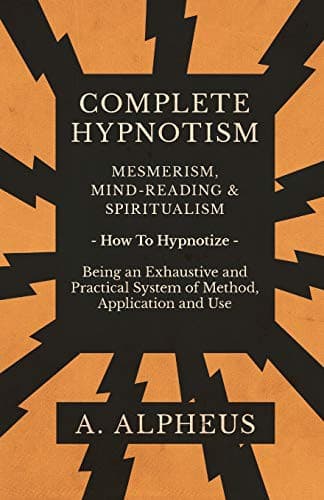
Complete Hypnotism, Mesmerism, Mind-Reading and Spiritualism: How to Hypnotize: Being an Exhaustive and Practical System of Method, Application, and UseAlpheus, A.
History
Complete Hypnotism, Mesmerism, Mind-Reading and Spiritualism: How to Hypnotize: Being an Exhaustive and Practical System of Method, Application, and Use
Alpheus, A.
Hypnotism; Mesmerism; Spiritualism; Telepathy
We may now turn our attention to another class of phenomena of great
interest, and that is the visions persons in the ordinary state have of
friends who are on the point of death. It would seem that by an
extraordinary effort the mind of a person in the waking state might be
impressed through a great distance. At the moment of death an almost
superhuman mental effort is more likely and possible than at any other
time, and it is peculiar that these visions or phantasms are largely
confined to that moment. The natural explanation that rises to the
ordinary mind is, of course, “Spirits.” This supposition is
strengthened by the fact that the visions sometimes appear immediately
after death, as well as at the time and just before. This may be
explained, however, on the theory that the ordinary mind is not easily
impressed, and when unconsciously impressed some time may elapse before
the impression becomes perceptible to the conscious mind, just as in
passing by on a swift train, we may see something, but not realize that
we have seen it till some time afterward, when we remember what we have
unconsciously observed.
The British Society for Psychical Research has compiled two large
volumes of carefully authenticated cases, which are published under the
title, “Phantasms of the Living.” We quote one or two interesting
cases.
A Miss L. sends the following report:
January 4, 1886.
“On one of the last days of July, about the year 1860, at 3 o’clock
p.m., I was sitting in the drawing room at the Rectory, reading, and my
thoughts entirely occupied. I suddenly looked up and saw most
distinctly a tall, thin old gentleman enter the room and walk to the
table. He wore a peculiar, old-fashioned cloak which I recognized as
belonging to my great-uncle. I then looked at him closely and
remembered his features and appearance perfectly, although I had not
seen him since I was quite a child. In his hand was a roll of paper,
and he appeared to be very agitated. I was not in the least alarmed, as
I firmly believed he was my uncle, not knowing then of his illness. I
asked him if he wanted my father, who, as I said, was not at home. He
then appeared still more agitated and distressed, but made no remark.
He then left the room, passing through the open door. I noticed that,
although it was a very wet day, there was no appearance of his having
walked either in mud or rain. He had no umbrella, but a thick walking
stick, which I recognized at once when my father brought it home after
the funeral. On questioning the servants, they declared that no one had
rung the bell; neither did they see any one enter. My father had a
letter by the next post, asking him to go at once to my uncle, who was
very ill in Leicestershire. He started at once, but on his arrival was
told that his uncle had died at exactly 3 o’clock that afternoon, and
had asked for him by name several times in an anxious and troubled
manner, and a roll of paper was found under his pillow.
Public-domain text, read in full here on John Shaqi.
Reviews
Reviews
No reviews yet
Be the first to share your thoughts on this work.
Elsewhere in the archive
Join the Discussion
Join the discussion
Sign in to leave a comment or review.
Sign InorCreate an account