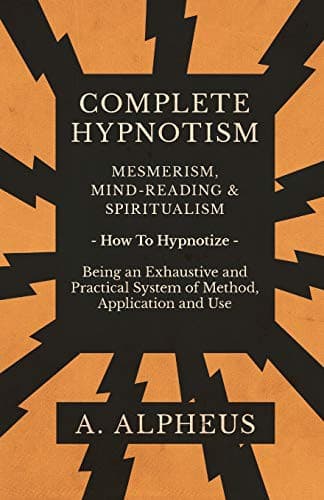
Complete Hypnotism, Mesmerism, Mind-Reading and Spiritualism: How to Hypnotize: Being an Exhaustive and Practical System of Method, Application, and UseAlpheus, A.
History
Complete Hypnotism, Mesmerism, Mind-Reading and Spiritualism: How to Hypnotize: Being an Exhaustive and Practical System of Method, Application, and Use
Alpheus, A.
Hypnotism; Mesmerism; Spiritualism; Telepathy
“That he (Mr. Marte), with his keen brain and marvelous perception,
will be interested, I know. He was a very dear friend of X. I was
exceedingly fond of him. Comical weather interests both he and
I—me—him—I know it all. Don’t you see I correct these? Well, I am not
less intelligent now. But there are many difficulties. I am far clearer
on all points than I was shut up in the prisoned body (prisoned,
prisoning or imprisoned you ought to say). No, I don’t mean, to get it
that way. ‘See here, H, don’t view me with a critic’s eye, but pass my
imperfections by.’ Of course, I know all that as well as anybody on
your sphere (of course). Well, I think so. I tell you, old fellow, it
don’t do to pick all these little errors too much when they amount to
nothing in one way. You have light enough and brain enough, I know, to
understand my explanations of being shut up in this body, dreaming, as
it were, and trying to help on science.”
Some people would say that Pelham had had a little too much whisky
toddy when he wrote that rambling, meaningless string of words. Or we
can suppose that Mrs. Piper was dreaming. We see in the last sentence a
curious mixture of ideas that must have been in her mind. She herself
says:
“I do not see how anybody can look on all that as testimony from
another world. I cannot see but that it must have been an unconscious
expression of my subliminal self, writing such stuff as dreams are made
of.”
In another place Mrs. Piper makes the following direct statement: “I
never heard of anything being said by myself while in a trance state
which might not have been latent in:
“1. My own mind.
“2. In the mind of the person in charge of the sitting.
“3. In the mind of the person who was trying to get communication with
some one in another state of existence, or some companion present with
such person, or,
“4. In the mind of some absent person alive somewhere else in the
world.”
Writing in the Psychological Review in 1898, Professor James says:
“Mrs. Piper’s trance memory is no ordinary human memory, and we have to
explain its singular perfection either as the natural endowment of her
solitary subliminal self, or as a collection of distinct memory
systems, each with a communicating spirit as its vehicle.
“The spirit hypothesis exhibits a vacancy, triviality, and incoherence
of mind painful to think of as the state of the departed, and coupled
with a pretension to impress one, a disposition to ‘fish’ and face
around and disguise the essential hollowness which is, if anything,
more painful still. Mr. Hodgson has to resort to the theory that,
although the communicants probably are spirits, they are in a
semi-comatose or sleeping state while communicating, and only half
aware of what is going on, while the habits of Mrs. Piper’s neural
organism largely supply the definite form of words, etc., in which the
phenomenon is clothed.”
After considering other theories Professor James concludes:
Public-domain text, read in full here on John Shaqi.
Reviews
Reviews
No reviews yet
Be the first to share your thoughts on this work.
Elsewhere in the archive
Join the Discussion
Join the discussion
Sign in to leave a comment or review.
Sign InorCreate an account