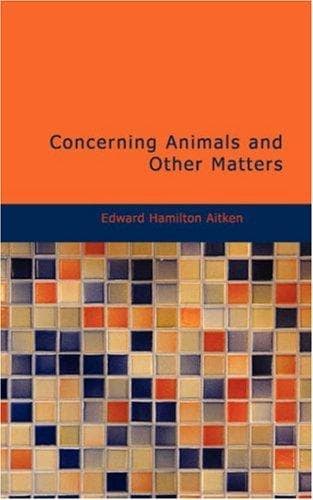
Concerning Animals and Other MattersAitken, Edward Hamilton
History
Concerning Animals and Other Matters
Aitken, Edward Hamilton
Animal behavior; India -- Social life and customs; Natural history
On every hand, in short, forces are at work stirring discontent in the
breasts of the younger generation with the existence which was the
heritage of their fathers. These forces operate from the outside, and
the mass is large and very inert: it would be rash to say that in the
heart of it there are not still millions who regard a monotonous
struggle for a bare existence as their portion from Providence. But when
a man who has travelled in India for half a cold season tells us that
the standard of living in India has deteriorated, we are tempted to
quote from Sir Ali Baba: "What is it that these travelling people put on
paper? Let me put it in the form of a conundrum. Q. What is it that the
travelling M.P. treasures up and the Anglo-Indian hastens to throw away?
A. Erroneous hazy, distorted impressions." "One of the most serious
duties attending a residence in India is the correcting of those
misapprehensions which your travelling M.P. sacrifices his bath to
hustle upon paper."
XIX
BORROWED INDIAN WORDS
Of the results of the Roman supremacy in Britain none have been so
permanent as their influence on our language. No doubt this was less due
to any direct effect that their residence among the Britons had at the
time on vernacular speech than to the fact that, for many centuries
after their departure, Latin was the language, throughout Europe, of
literature and scholarship. Our supremacy in India is acting on the
languages of that country in both ways, and though it has scarcely
lasted half as long yet as the Roman rule in Britain, English already
bids fair to become one day the common tongue of the Hindus. But there
is also a current flowing the other way, comparatively insignificant,
but curious and interesting.
Few persons in England are aware how often they use words of Indian
origin in common speech. In attempting to give a list of these I will
exclude the trade names of articles of Indian produce or manufacture,
which have no literary interest, and also words which indicate objects,
ideas or customs that are not English, and therefore have no English
equivalents, such as "tom-tom," "sepoy" and "suttee," I will also omit
Indian words, such as "bundobust," and "griffin," which are used by
writers like Thackeray in the same way in which French terms are
commonly introduced into English composition.
Public-domain text, read in full here on John Shaqi.
Reviews
Reviews
No reviews yet
Be the first to share your thoughts on this work.
Elsewhere in the archive
Join the Discussion
Join the discussion
Sign in to leave a comment or review.
Sign InorCreate an account