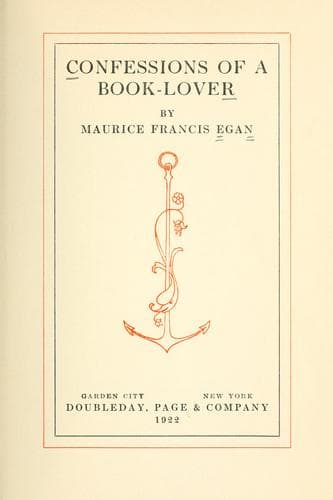
While I write this, I have in mind a little essay of great charm and
value by Coventry Patmore on "Modern Ideas of Purity," which goes deeper
into the fundamentals of morality than any other modern work on the
subject. And, by the way, having read "The Age of Innocence," "Main
Street," "Moon Calf," "Miss Lulu Bett," and several other novels, I turn
from their lack of gaiety to find a reason why art should not be gloomy,
and here it is, from Coventry Patmore's "Cheerfulness in Life and Art."
"Rejoice always: and again I say, Rejoice," says one of the highest
authorities; and a poet who is scarcely less infallible in
psychological science writes, "A cheerful heart is what the Muses
love."
Dante shows Melancholy dismally punished in Purgatory; though his
own interior gaiety--of which a word by and by--is so interior, and
its outward aspect often so grim, that he is vulgarly considered to
have himself been a sinner in this sort. Good art is nothing but a
representation of life; and that the good are gay is a commonplace,
and one which, strange to say, is as generally disbelieved as it
is, when rightly understood, undeniably true. The good and brave
heart is always gay in this sense: that, although it may be
afflicted and oppressed by its own misfortunes and those of others,
it refuses in the darkest moment to consent to despondency; and
thus a habit of mind is formed which can discern in most of its own
afflictions some cause for grave rejoicing, and can thence infer at
least a probability of such cause in cases where it cannot be
discerned. Regarding thus cheerfully and hopefully its own sorrows,
it is not overtroubled by those of others, however tender and
helpful its sympathies may be. It is impossible to weep much for
that in others which we should smile at in ourselves; and when we
see a soul writhing like a worm under what seems to us a small
misfortune, our pity for its misery is much mitigated by contempt
for its cowardice.
There may be gaiety and joy in the novels of Harold Bell Wright and Mrs.
Gene Stratton-Porter, but it seems to me to be a cheerfulness which is
not quite the real thing. It is too sentimental and rather too laboured.
These two authors, who, if the value of a writer could really depend on
the majority of the votes cast for him, would, with the goldenrod, be
our national flowers, seem to work too hard in the pursuit of
cheerfulness.
Public-domain text, read in full here on John Shaqi.
Reviews
Reviews
No reviews yet
Be the first to share your thoughts on this work.
Elsewhere in the archive
Join the Discussion
Join the discussion
Sign in to leave a comment or review.
Sign InorCreate an account