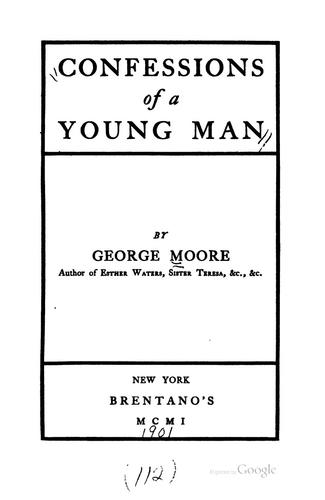
Moore, George, 1852-1933; Paris (France) -- Intellectual life
I have heard that Mr. Hardy is country bred, but I should not have
discovered this from his writings. They read to me more like a report, yes,
a report,--a conscientious, well-done report, executed by a thoroughly
efficient writer sent down by one of the daily papers. Nowhere do I find
selection, everything is reported, dialogues and descriptions. Take for
instance the long evening talk between the farm people when Oak is seeking
employment. It is not the absolute and literal transcript from nature after
the manner of Henri Monier; for that it is a little too diluted with Mr.
Hardy's brains, the edges are a little sharpened and pointed, I can see
where the author has been at work filing; on the other hand, it is not
synthesized--the magical word which reveals the past, and through which we
divine the future--is not seized and set triumphantly as it is in "Silas
Marner." The descriptions do not flow out of and form part of the
narrative, but are wedged in, and often awkwardly. We are invited to assist
at a sheep-shearing scene, or at a harvest supper, because these scenes are
not to be found in the works of George Eliot, because the reader is
supposed to be interested in such things, because Mr. Hardy is anxious to
show how jolly country he is.
Collegians, when they attempt character-drawing, create monstrosities, but
a practised writer should be able to create men and women capable of moving
through a certain series of situations without shocking in any violent way
the most generally applicable principles of common sense. I say that a
practised writer should be able to do this; that they sometimes do not is a
matter which I will not now go into, suffice it for my purpose if I admit
that Mr. Hardy can do this. In farmer Oak there is nothing to object to;
the conception is logical, the execution is trustworthy; he has legs, arms,
and a heart; but the vital spark that should make him of our flesh and of
our soul is wanting, it is dead water that the sunlight never touches. The
heroine is still more dim, she is stuffy, she is like tow; the rich farmer
is a figure out of any melodrama, Sergeant Troy nearly quickens to life;
now and then the clouds are liquescent, but a real ray of light never
falls.
Public-domain text, read in full here on John Shaqi.
Reviews
Reviews
No reviews yet
Be the first to share your thoughts on this work.
Elsewhere in the archive
Join the Discussion
Join the discussion
Sign in to leave a comment or review.
Sign InorCreate an account