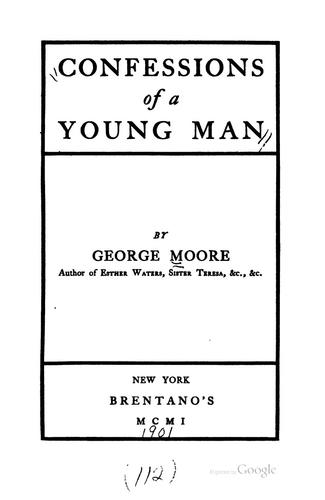
Moore, George, 1852-1933; Paris (France) -- Intellectual life
I read the "Story of Elizabeth" by Miss Thackeray. It came upon me with all
the fresh and fair naturalness of a garden full of lilacs and blue sky, and
I thought of Hardy, Blackmore, Murray, and Besant as of great warehouses
where everything might be had, and even if the article required were not in
stock it could be supplied in a few days at latest. The exquisite little
descriptions, full of air, colour, lightness, grace; the French life seen
with such sweet English eyes; the sweet little descriptions all so gently
evocative. "What a tranquil little kitchen it was, with a glimpse of the
courtyard outside, and the cocks and hens, and the poplar trees waving in
the sunshine, and the old woman sitting in her white cap busy at her homely
work." Into many wearisome pages these simple lines have since been
expanded, without affecting the beauty of the original. "Will Dampier
turned his broad back and looked out of the window. There was a moment's
silence. They could hear the tinkling of bells, the whistling of the sea,
the voices of the men calling to each other in the port, the sunshine
streamed in; Elly was standing in it, and seemed gilt with a golden
background. She ought to have held a palm in her hand, poor little martyr!"
There is sweet wisdom in this book, wisdom that is eternal, being simple;
and near may not come the ugliness of positivism, nor the horror of
pessimism, nor the profound greyness of Hegelism, but merely the genial
love and reverence of a beautiful-minded woman.
Such charms as these necessitate certain defects, I should say limitations.
Vital creation of character is not possible to Miss Thackeray, but I do not
rail against beautiful water-colour indications of balconies, vases,
gardens, fields, and harvesters because they have not the fervid glow and
passionate force of Titian's Ariadne; Miss Thackeray cannot give us a
Maggie Tulliver, and all the many profound modulations of that
Beethoven-like countryside: the pine wood and the cripple; this aunt's
linen presses, and that one's economies; the boy going forth to conquer the
world, the girl remaining at home to conquer herself; the mighty river
holding the fate of all, playing and dallying with it for a while, and
bearing it on at last to final and magnificent extinction. That sense of
the inevitable which had the Greek dramatists wholly, which had George
Eliot sufficiently, that rhythmical progression of events, rhythm and
inevitableness (two words for one and the same thing) is not there. Elly's
golden head, the back-ground of austere French Protestants, is sketched
with a flowing water-colour brush, I do not know if it is true, but true or
false in reality, it is true in art. But the jarring dissonance of her
marriage is inadmissible; it cannot be led up to by chords no matter how
ingenious, the passage, the attempts from one key to the other, is
impossible; the true end is the ruin, by death or lingering life, of Elly
and the remorse of the mother.
Public-domain text, read in full here on John Shaqi.
Reviews
Reviews
No reviews yet
Be the first to share your thoughts on this work.
Elsewhere in the archive
Join the Discussion
Join the discussion
Sign in to leave a comment or review.
Sign InorCreate an account