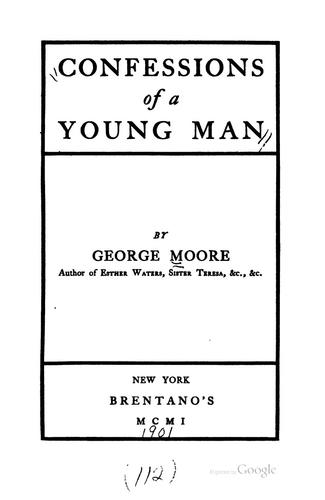
Moore, George, 1852-1933; Paris (France) -- Intellectual life
But conservative though we were in matters concerning "copy," though all
means were taken to protect ourselves against interlopers, one who had not
passed the preliminary stage of straddling would occasionally slip through
our defences. I remember one especially. It was a hot summer's day, we were
all on the counter, our legs swinging, when an enormous young man entered.
He must have been six feet three in height. He was shown into Mr. B.'s
room, he asked him to read a MS., and he fled, looking very frightened.
"Wastepaper basket, wastepaper basket," we shouted when Mr. B. handed us
the roll of paper. "What an odd-looking fish he is!" said O'Flanagan; "I
wonder what his MS. is like." We remonstrated in vain, O'Flanagan took the
MS. home to read, and returned next morning convinced that he had
discovered an embryo Dickens. The young man was asked to call, his book was
accepted, and we adjourned to the bar.
A few weeks afterwards this young man took rooms in the house next to me on
the ground floor. He was terribly inflated with his success, and was
clearly determined to take London by storm. He had been to Oxford, and to
Heidelberg, he drank beer and smoked long pipes, he talked of nothing else.
Soon, very soon, I grew conscious that he thought me a simpleton; he
pooh-poohed my belief in Naturalism and declined to discuss the symbolist
question. He curled his long legs upon the rickety sofa and spoke of the
British public as the "B.P.," and of the magazine as the "mag." There were
generally tea-things and jam-pots on the table. In a little while he
brought a little creature about five feet three to live with him, and when
the little creature and the long creature went out together, it was like
Don Quixote and Sancho Panza setting forth in quest of adventures in the
land of Strand. The little creature indulged in none of the loud, rasping
affectation of humour that was so maddening in the long creature; the
little creature was dry, hard, and sterile, and when he did join in the
conversation it was like an empty nut between the teeth--dusty and bitter.
He was supposed to be going in for the law, but the part of him to which he
drew our attention was his knowledge of the Elizabethan dramatists. He kept
a pocket-book, in which he held an account of his reading. Holding the
pocket-book between finger and thumb, he would say, "Last year I read ten
plays by Nash, twelve by Peele, six by Greene, fifteen by Beaumont and
Fletcher, and eleven anonymous plays,--fifty-four in all." He neither
praised nor blamed, he neither extolled nor criticised; he told you what he
had read, and left you to draw your own conclusions.
Public-domain text, read in full here on John Shaqi.
Reviews
Reviews
No reviews yet
Be the first to share your thoughts on this work.
Elsewhere in the archive
Join the Discussion
Join the discussion
Sign in to leave a comment or review.
Sign InorCreate an account