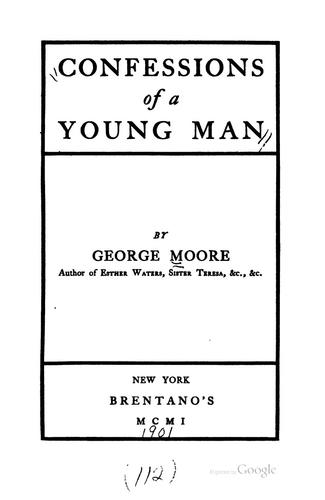
Moore, George, 1852-1933; Paris (France) -- Intellectual life
puzzled me, who was I to ask to be my second? My old friends were
scattered, they had disappeared; and among my new acquaintances I could not
think of one that would do. None of the Straddlers would do, that was
certain; I wanted some one that could be depended upon, and whose social
position was above question. Among my old friends I could think of some
half-dozen that would suit me perfectly, but where were they? Ten years'
absence scatters friends as October scatters swallows. At last my thoughts
fixed themselves on one man. I took a hansom and drove to his house. I
found him packing up, preparing to go abroad. This was not fortunate. I
took a seat on the edge of the dining-room table, and told him I wanted him
to act for me in an affair of honour. I told him the story in outline. "I
suppose," he said, "it was about one or two in the morning?"
"Later than that," I said; "it was about seven."
"My dear fellow, he struck you, and not very hard, I should imagine; you
hit him with a champagne bottle, and now you want to have him out. I don't
mind acting as intermediary, and settling the affair for you; he will no
doubt regret he struck you, and you will regret you struck him; but really
I cannot act for you, that is to say, if you are determined to force on a
meeting. Just think; supposing you were to shoot him, a man who has really
done you no wrong."
"My dear ----, I did not come here to listen to moral reflections; if you
don't like to act for me, say so."
I telegraphed to Warwickshire to an old friend:--"Can I count on you to act
for me in an affair of honour?" Two or three hours after the reply came.
"Come down here and stay with me for a few days, we'll talk it over." I
ground my teeth; what was to be done? I must wire to Marshall and ask him
to come over; English people evidently will have nothing to do with serious
duelling. "Of all importance. Come over at once and act for me in an affair
of honour. Bring the count with you; leave him at Boulogne; he knows the
colonel of the ----." The next day I received the following: "Am burying my
father; so soon as he is underground will come." Was there ever such
luck?... He won't be here before the end of the week. These things demand
the utmost promptitude. Three or four days afterwards dreadful Emma told me
a gentleman was upstairs taking a bath. "Holloa, Marshall, how are you? Had
a good crossing? Awful good of you to come.... The poor old gentleman went
off quite suddenly, I suppose?"
"Yes; found dead in his bed. He must have known he was dying, for he lay
quite straight as the dead lie, his hands by his side ... wonderful
presence of mind."
"He left no money?"
"Not a penny; but I could manage it all right. Since my success at the
Salon, I have been able to sell my things. I am only beginning to find out
now what a success that picture was. _Je t'assure, je fais
l'école._"...
"_Tu crois ça ... on fait l'école après vingt ans de travail._"
Public-domain text, read in full here on John Shaqi.
Reviews
Reviews
No reviews yet
Be the first to share your thoughts on this work.
Elsewhere in the archive
Join the Discussion
Join the discussion
Sign in to leave a comment or review.
Sign InorCreate an account