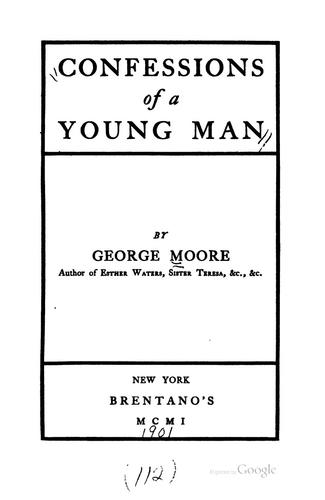
Moore, George, 1852-1933; Paris (France) -- Intellectual life
I took up "Rhoda Fleming." I found some exquisite bits of description in
it, but I heartily wished them in verse, they were motives for poems;
and there was some wit. I remember a passage very racy indeed, of
middle-class England. Antony, I think, is the man's name, describes how
he is interrupted at his tea; a paragraph of seven or ten lines with "I
am having my tea, I am at my tea," running through it for refrain. Then
a description of a lodging-house dinner: "a block of bread on a lonely
place, and potatoes that looked as if they had committed suicide in
their own steam." A little ponderous and stilted, but undoubtedly witty.
I read on until I came to a young man who fell from his horse, or had
been thrown from his horse, I never knew which, nor did I feel enough
interest in the matter to make research; the young man was put to bed by
his mother, and once in bed he began to talk!...four, five, six, ten
pages of talk, and such talk! I can offer no opinion why Mr George
Meredith committed them to paper; it is not narrative, it is not witty,
nor is it sentimental, nor is it profound. I read it once; my mind,
astonished at receiving no sensation, cried out like a child at a
milkless breast. I read the pages again...did I understand? Yes, I
understood every sentence, but they conveyed no idea, they awoke no
emotion in me; it was like sand, arid and uncomfortable. The story is
surprisingly commonplace--the people in it are as lacking in subtlety as
those of a Drury Lane melodrama.
"Diana of the Crossways" I liked better, and had I had absolutely
nothing to do I might have read it to the end. I remember a scene with a
rustic--a rustic who could eat hog a solid hour--that amused me. I
remember the sloppy road in the Weald, and the vague outlines of the
South Downs seen in starlight and mist. But to come to the great
question, the test by which Time will judge us all--the creation of a
human being, of a live thing that we have met with in life before, and
meet for the first time in print, and who abides with us ever after.
Into what shadow has not Diana floated? Where are the magical glimpses
of the soul? Do you remember in "Pères et Enfants," when Tourgueneff is
unveiling the woman's, shall I say, affection, for Bazaroff, or the
interest she feels in him? and exposing at the same time the reasons why
she will never marry him...I wish I had the book by me, I have not seen
it for ten years.
After striving through many pages to put Lucien, whom you would have
loved, whom I would have loved, that divine representation of all that
is young and desirable in man, before the reader, Balzac puts these
words in his mouth in reply to an impatient question by Vautrin, who
asks him what he wants, what he is sighing for, "_D'être célèbre et
d'être aimè_,"--these are soul-waking words, these are Shakespearean
words.
Public-domain text, read in full here on John Shaqi.
Reviews
Reviews
No reviews yet
Be the first to share your thoughts on this work.
Elsewhere in the archive
Join the Discussion
Join the discussion
Sign in to leave a comment or review.
Sign InorCreate an account