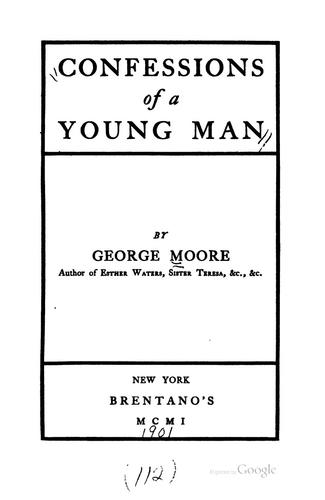
Moore, George, 1852-1933; Paris (France) -- Intellectual life
The story-tellers are no doubt right when they insist on the difficulty
of telling a story. A sequence of events--it does not matter how simple
or how complicated--working up to a logical close, or, shall I say, a
close in which there is a sense of rhythm and inevitableness is always
indicative of genius. Shakespeare affords some magnificent examples,
likewise Balzac, likewise George Eliot, likewise Tourgueneff; the
"Œdipus" is, of course, the crowning and final achievement in the music
of sequence and the massy harmonies of fate. But in contemporary
English fiction I marvel, and I am repeatedly struck by the inability of
writers, even of the first-class, to make an organic whole of their
stories. Here, I say, the course is clear, the way is obvious, but no
sooner do we enter on the last chapters than the story begins to show
incipient shiftiness, and soon it doubles back and turns, growing with
every turn weaker like a hare before the hounds. From a certain
directness of construction, from the simple means by which Oak's ruin is
accomplished in the opening chapters, I did not expect that the story
would run hare-hearted in its close, but the moment Troy told his wife
that he never cared for her, I suspected something was wrong; when he
went down to bathe and was carried out by the current I knew the game
was up, and was prepared for anything, even for the final shooting by
the rich farmer, and the marriage with Oak, a conclusion which of course
does not come within the range of literary criticism.
"Lorna Doone" struck me as childishly garrulous, stupidly prolix,
swollen with comments not interesting in themselves and leading to
nothing. Mr Hardy possesses the power of being able to shape events; he
can mould them to a certain form; that he cannot breathe into them the
spirit of life I have already said, but "Lorna Doone" reminds me of a
third-rate Italian opera, _La Fille du Régiment_ or _Ernani_; it is
corrupt with all the vices of the school, and it does not contain a
single passage of real fervour or force to make us forget the inherent
defects of the art of which it is a poor specimen. Wagner made the
discovery, not a very wonderful one after all when we think, that an
opera had much better be melody from end to end. The realistic school
following on Wagner's footsteps discovered that a novel had much better
be all narrative--an uninterrupted flow of narrative. Description is
narrative, analysis of character is narrative, dialogue is narrative;
the form is ceaselessly changing, but the melody of narration is never
interrupted.
Public-domain text, read in full here on John Shaqi.
Reviews
Reviews
No reviews yet
Be the first to share your thoughts on this work.
Elsewhere in the archive
Join the Discussion
Join the discussion
Sign in to leave a comment or review.
Sign InorCreate an account