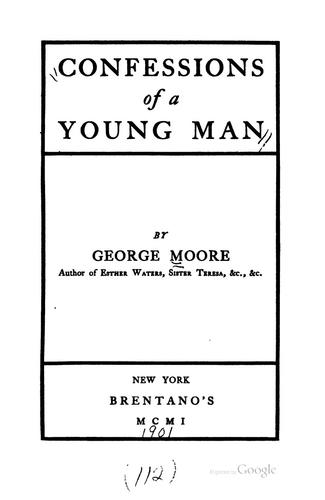
Moore, George, 1852-1933; Paris (France) -- Intellectual life
The subject is not unfamiliar to me; I come to it like the son to his
father, like the bird to its nest. (Singularly inappropriate comparison,
but I am in such excellent humour to-day; humour is everything. It is
said that the tiger will sometimes play with the lamb! Let us play.) We
have the villa well in our mind. The father who goes to the city in the
morning, the grown-up girls waiting to be married, the big drawing-room
where they play waltz music, and talk of dancing parties. But waltzes
will not entirely suffice, nor even tennis; the girls must read. Mother
cannot keep a censor (it is as much as she can do to keep a cook,
housemaid and page-boy), besides the expense would be enormous, even if
nothing but shilling and two-shilling novels were purchased. Out of such
circumstances the circulating library was hatched.
The villa made known its want, and art fell on its knees. Pressure was
put on the publishers, and books were published at 31s. 6d.; the dirty
outside public was got rid of, and the villa paid its yearly
subscription, and had nice large handsome books that none but the
_élite_ could obtain, and with them a sense of being put on a footing of
equality with my Lady This and Lady That, and certainty that nothing
would come into the hands of dear Kate and Mary and Maggie that they
might not read, and all for two guineas a year. English fiction became
pure, and the garlic and assafœtida with which Byron, Fielding and Ben
Jonson so liberally seasoned their works, and in spite of which, as
critics say, they were geniuses, have disappeared from our literature.
English fiction became pure, dirty stories were to be heard no more,
were no longer procurable. But at this point human nature intervened;
poor human nature! when you pinch it in one place it bulges out in
another, after the fashion of a lady's figure. Human nature has from the
earliest time shown a liking for dirty stories; dirty stories have
formed a substantial part of every literature (I employ the words "dirty
stories" in the circulating library sense); therefore a taste for dirty
stories may be said to be inherent in the human animal. Call it a
disease if you will--an incurable disease--which, if it is driven
inwards, will break out in an unexpected quarter in a new form and with
redoubled virulence. This is exactly what has happened. Actuated by the
most laudable motives, Mudie cut off our rations of dirty stories, and
for forty years we were apparently the most moral people on the face of
the earth. It was confidently asserted that an English woman of sixty
would not read what would bring the blush of shame to the cheeks of a
maiden of any other nation. But humiliation and sorrow were awaiting
Mudie. True it is that we still continued to subscribe to his library,
true it is that we still continued to go to church, true it is that we
turned our faces away when _Mdlle. de Maupin_ or the _Assommoir_ was
spoken of; to all appearance we were as good and chaste as even Mudie
Public-domain text, read in full here on John Shaqi.
Reviews
Reviews
No reviews yet
Be the first to share your thoughts on this work.
Elsewhere in the archive
Join the Discussion
Join the discussion
Sign in to leave a comment or review.
Sign InorCreate an account