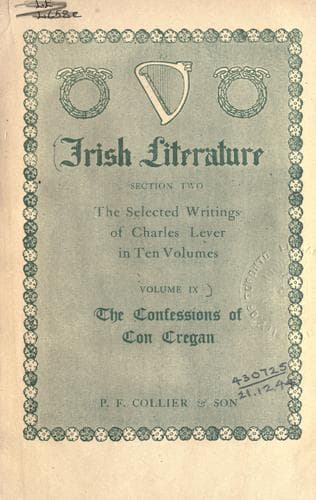
Confessions Of Con Cregan, the Irish Gil BlasLever, Charles
General
Confessions Of Con Cregan, the Irish Gil Blas
Lever, Charles
Ireland -- Fiction
No speculations are pleasanter, when indulged at our own fireside, in an
easy-chair, after having solaced our "material" nature by a good dinner,
and satisfied the "moral" man by the "City Article," which assures us
that the Three per Cents are rising, and that Consols for the Account
are in a very prosperous state. Then, indeed, if our thoughts by any
accident stray to the shipwrecked sailor, they are blended with
a wholesome philanthropy, born of good digestion and fair worldly
prospects; we assure ourselves that we should have made precisely the
same exertions that he did, and comported ourselves in all the varied
walks of carpenter, tailor, hosier, sail-maker, and boat-builder exactly
like him. The chances are, too, that if accidentally out of temper with
our neighbors, we cordially acknowledge that the retirement was not
the worst feature in his history; and if provoked by John Thomas, the
footman, we are ready to swear that there was more gratitude in Friday's
little black finger than in the whole body corporate of flunkeys, from
Richmond to Blackwall.
While these very laudable sentiments are easy enough in the
circumstances I have mentioned, they are marvellously difficult to
practise at the touch of stern reality. At least I found them so, as
I set out to seek the "Refuge" on Anticosti. It was just daybreak as,
somewhat stiffened with a sleep on the cold beach, and sore from my
recent bruises, I began my march. "Nor'-west and by west" was Halkett's
vague direction to me; but as I had no compass, I was left to the
guidance of the rising sun for the cardinal points. Not a path nor track
of any kind was to be seen; indeed, the surface could scarcely have
borne traces of footsteps, for it was one uniform mass of slaty shingle,
with here and there the backbone of a fish, and scattered fragments
of seaweed, washed up by the storms, on this low bleak shore. I
cannot fancy desolation more perfect than this dreary spot; slightly
undulating, but never sufficient to lose sight of the sea; not a
particle of shelter to be found; not a rock, nor even a stone large
enough to sit upon when weary. Of vegetation, no trace could be met
with; even a patch of moss or a lichen would have been a blessing to
see; but there were neither. At last, as I journeyed on, I wandered
beyond the sound of the sea as it broke upon the low strand, and then
the silence became actually appalling. But a few moments back, and the
loud booming of the breakers stunned the ear; and now, as I stopped
to listen, I could hear my own heart as in full, thick beat it smote
against my ribs. I could not dismiss the impression that such a
stillness, thus terrible, would prevail on the day of judgment, when,
after the graves had given up their millions of dead, and the agonizing
cry for mercy had died away, then, as in a moment of dread suspense, the
air would be motionless, not a leaf to stir, not a wing to cleave it.
Public-domain text, read in full here on John Shaqi.
Reviews
Reviews
No reviews yet
Be the first to share your thoughts on this work.
Elsewhere in the archive
Join the Discussion
Join the discussion
Sign in to leave a comment or review.
Sign InorCreate an account