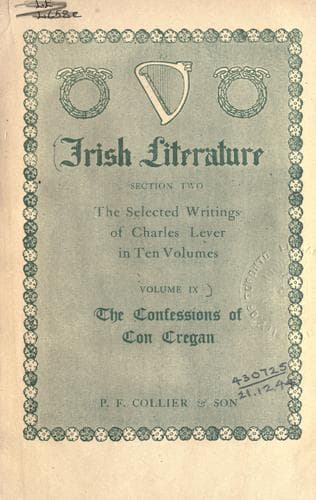
Confessions Of Con Cregan, the Irish Gil BlasLever, Charles
General
Confessions Of Con Cregan, the Irish Gil Blas
Lever, Charles
Ireland -- Fiction
The hag, apparently moved by the ready compliance to make the best
of matters, went out, and returned with some more wood,--fragments of
ship-timber,--which she offered us, saying, "'T is all I can give yez.
Good night to yez all!"
"Well, father," said Joe, as soon as he had lighted his pipe, and taken
a seat by the fire, "ye wor tired enough of the ship, but I think ye
wish yerself back again there, now."
"I wish more nor that," said the old man, querulously; "I wish I never
seen the same ship; nor ever left ould Ireland!"
This sentiment threw a gloom over the whole party, by awakening, not
only memories of home and that far-away land, but also by the confession
of a sense of disappointment which each was only able to struggle
against while unavowed. The sorrow made them silent, and at last sleepy.
At first, the three "boys," great fellows of six feet high, stretched
themselves full-length on the floor, and snored away in concert; then
the two girls, one with her head on the other's lap, fell off; while
the old man, sitting directly in front of the fire, nodded backwards
and forwards, waking up, every half hour or so, to light his pipe; which
done, he immediately fell off into a doze once more, leaving Joe and
myself alone, waking and watchful.
CHAPTER XVI. A NIGHT IN THE LOWER TOWN
Joe's eyes were bent upon me, as I sat directly opposite him, with a
fixedness that I could easily see was occasioned by my showy costume;
his glances ranged from my buckled shoes to my white cravat, adorned
with a splendid brooch of mock amethyst; nay, I almost fancied once that
he was counting the silver clocks on my silk stockings! It was a look of
most undisguised astonishment,--such a look as one bestows upon some
new and singular animal, of whose habits and instincts we are lost in
conjecture.
Now, I was "York too,"--that is to say, I was Irish as well as himself;
and I well knew that there was no rank nor condition of man for which
the peasant in Ireland conceives the same low estimate as the "Livery
Servant." The class is associated in his mind with chicanery, impudence,
falsehood, theft, and a score of similar good properties; not to add
that, being occasionally, in great families, a native of England, the
Saxon element is united to the other "bitters" of the potion.
Public-domain text, read in full here on John Shaqi.
Reviews
Reviews
No reviews yet
Be the first to share your thoughts on this work.
Elsewhere in the archive
Join the Discussion
Join the discussion
Sign in to leave a comment or review.
Sign InorCreate an account