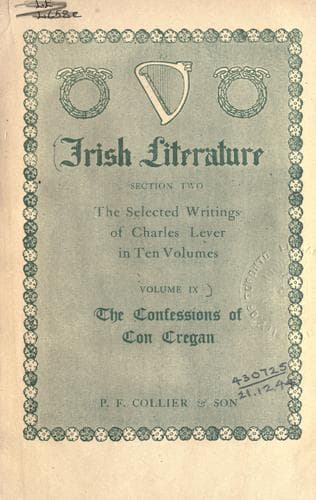
Confessions Of Con Cregan, the Irish Gil BlasLever, Charles
General
Confessions Of Con Cregan, the Irish Gil Blas
Lever, Charles
Ireland -- Fiction
A more pitiable object it would not be easy to picture. The blood oozing
from my wound, re-opened by the exertion, had stained my flannel dress,
which, ragged and torn, gave glimpses of a figure reduced almost to a
skeleton. My beard was long, adding to the seeming length of my gaunt
and lantern jaws, blue with fatigue and fasting. My shoes were in
tatters, and gave no protection to my bleeding feet; while my hands
were torn and cut by grasping the rocks and boughs in my descent.
Half-stumbling, half-tottering, I came onward till I found myself close
to the great fire, at the base of a mound--a "Prairie roll," as it is
called--which formed a shelter against the east wind.
Around the immense blaze sat a party, some of whom in shadow, others
in strong light, presented a group the strangest ever my eyes beheld.
Bronzed and bearded countenances, whose fierce expression glowed fiercer
in the ruddy glare of the fire, were set off by costumes the oddest
imaginable.
Many wore coats of undressed sheepskin, with tall caps of the same
material; others had ragged uniforms of different services. One or two
were dressed in "ponchos" of red-brown cloth, like Mexicans, and some,
again, had a kind of buff coat studded with copper ornaments,--a
costume often seen among the half-breeds. All agreed in one feature
of equipment, which was a broad leather belt or girdle, in which were
fastened various shining implements, of which a small pickaxe and a
hammer were alone distinguishable where I stood. Several muskets were
piled near them, and on the scorched boughs of the cedars hung a little
armory of cutlasses, pistols, and "bowies," from which I was able to
estimate the company at some twenty-eight or thirty in number. Packs and
knapsacks, with some rude cooking utensils, were strewn around; but
the great carcase of a deer which I saw in the flames, supported by a
chevaux-de-frise of ramrods, was the best evidence that the cares of
"cuisine" did not demand any unnecessary aid from "casseroles."
A couple of great earthen pitchers passed rapidly from hand to hand
round the circle, and, by the assistance of some blackhead, served to
beguile the time while the "roast" was being prepared.
Public-domain text, read in full here on John Shaqi.
Reviews
Reviews
No reviews yet
Be the first to share your thoughts on this work.
Elsewhere in the archive
Join the Discussion
Join the discussion
Sign in to leave a comment or review.
Sign InorCreate an account