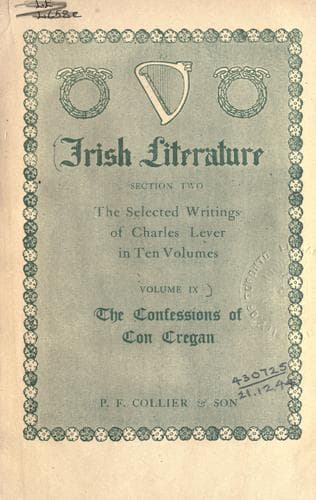
Confessions Of Con Cregan, the Irish Gil BlasLever, Charles
General
Confessions Of Con Cregan, the Irish Gil Blas
Lever, Charles
Ireland -- Fiction
The prairie was fruitful in incidents to test my courage. As the season
wore on, and game became more scarce, we were compelled to pursue the
"bison" into distant tracks, verging upon the hunting-grounds of an
Indian tribe called the Camanches. At first our "rencontres" were
confined to meeting with a scout or some small outlying party of the
tribe; but later on we ventured farther within their frontier, and upon
one occasion we penetrated a long and winding ravine which expanded into
a small plain, in the midst of which, to our amazement, we beheld their
village.
The scene was in every way a striking one. It was a few minutes after
sunset, and while yet the "yellow glory" of the hour bathed the earth,
that we saw the cane wigwams of the "Camanches" as they stood at either
side of a little river that, with many a curve, meandered through the
plain. Some squaws were seated on the banks, and a number of children
were sporting in the stream, which appeared too shallow for swimming.
Here and there, at the door of the wigwams, an old man was sitting
smoking. Some mustangs, seemingly fresh caught, were picketed in a
circle, and a few boys were amusing themselves, tormenting the animals
into bounds and curvets, the laughter the sport excited being audible
where we stood. The soft influence of the hour, the placid beauty of the
picture, the semblance of tranquil security impressed on everything,
the very childish gambols,--were all images so full of home and homelike
memories that we halted and gazed on the scene in speechless emotion.
Perhaps each of us at that moment had traversed in imagination half a
world of space, and was once again a child! As for myself, infancy
had been "no fairy dream," and yet my eyes filled up, and yet my lip
quivered, as I looked.
It was evident that the warriors of the tribe were absent on some
expedition. The few figures that moved about were either the very
old, the very young, or the squaws, who, in all the enjoyment of that
gossiping, as fashionable in the wild regions of the West as in the
gilded boudoirs of Paris, sat enjoying the cool luxury of the twilight.
Our party consisted of only four and myself; and standing, as we did,
in a grove of nut-trees, were perfectly concealed from view: no sense
of danger then interfered with our enjoyment of the prospect; we gazed
calmly on the scene on which we looked.
"Senhor Condé," whispered one of my party, a swarthy Spaniard from the
Basque, "what a foray we might make yonder! Their young men are absent;
they could make no defence. Caramba! it would be rare sport."
"Condé mio!" cried a Mexican, who had once been a horse-dealer, "I see
mustangs yonder worth five hundred dollars, if they are worth a cent;
let us have a dash forward and carry them off."
"There is gold in that village," muttered an old Ranchero, with a white
moustache; "I see sifting-sieves drying beside the stream."
Public-domain text, read in full here on John Shaqi.
Reviews
Reviews
No reviews yet
Be the first to share your thoughts on this work.
Elsewhere in the archive
Join the Discussion
Join the discussion
Sign in to leave a comment or review.
Sign InorCreate an account