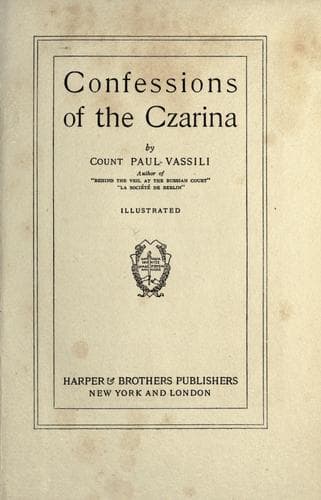
Confessions of the CzarinaRadziwill, Catherine, Princess
History
Confessions of the Czarina
Radziwill, Catherine, Princess
Alexandra, Empress, consort of Nicholas II, Emperor of Russia, 1872-1918; Russia -- Court and courtiers
Nicholas II. had always detested republics, and though he had been made
much of during his visits to Paris, which he had thoroughly enjoyed, he
yet had never felt quite at home amid the Republican society he had been
called upon to get acquainted with; in the secret of his heart he
despised all French political men, whom he considered as much inferior
to himself. But a natural inclination to dissimulation, which he carried
so far that many people called it by quite another name, had made him
carefully conceal the real state of his feelings in regard to his French
ally. It is, however, quite certain that if the war had not broken out
the Franco-Russian alliance would have died a natural death. As things
occurred, it was for a short space of time to appear more complete than
ever; this was not the merit of Nicholas, but the result of the honesty
which the French Government brought to bear in all that happened in
1914. In Russian Court circles, which were all of them, more or less,
given up to Germany, the news that the country was going to war was
received with consternation, and there were many people who declared
that it was a shame for Russia to be drawn into a struggle which was
essentially a personal quarrel between France and Germany, with which
she had nothing to do.
At first and before the anti-German feeling became fierce in St.
Petersburg, the Empress, in spite of political complications, remained
in private correspondence with her brother, and through him with the
Kaiser, to whom she promised that she would spare no efforts to induce
the Czar to conclude peace as soon as it became practicable. She had
never been able to form an idea of the power which public opinion,
especially in times of national danger, can exercise over a nation. She
imagined that the authority wielded by the Crown would be sufficient to
put an end to any manifestations of sympathy in regard to France on the
part of the Russian people. She therefore felt confident that the
struggle which had just begun would not last long, and that Russia could
come out of it, if not with flying colors, at least without any serious
losses.
No one during those early days of the war admitted for one moment the
possibility that Warsaw and the line of fortresses which defended the
Russian frontier on the side of the Niemen could fall into the hands of
the enemy; all that the Empress expected was a defeat of the Russian
armies which would not seriously compromise their prestige, but at the
same time convince the country that an advantageous peace was, after
all, the best way of getting out of a situation where all the time one
adversary had either willingly or unwillingly misunderstood the good
intentions of the other.
Public-domain text, read in full here on John Shaqi.
Reviews
Reviews
No reviews yet
Be the first to share your thoughts on this work.
Elsewhere in the archive
Join the Discussion
Join the discussion
Sign in to leave a comment or review.
Sign InorCreate an account