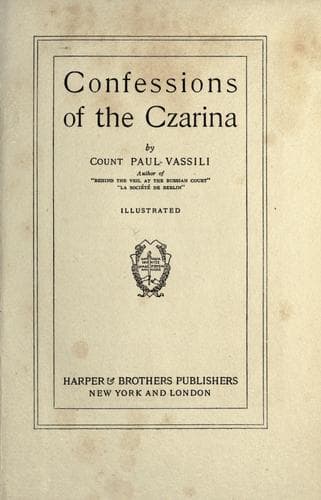
Confessions of the CzarinaRadziwill, Catherine, Princess
History
Confessions of the Czarina
Radziwill, Catherine, Princess
Alexandra, Empress, consort of Nicholas II, Emperor of Russia, 1872-1918; Russia -- Court and courtiers
The Empress was still smarting under the sense of her personal defeat in
a struggle against the people who were trying to control Russian
politics and to lead them in a road she strongly objected taking, when
the news of the defeat of the Russian army at Tannenberg came like a
thunderbolt out of the blue, to stir up all the patriotic feelings of
the Russian nation and to put an end to any idea of peace which may have
existed in some timorous minds. The Empress had perforce to appear to
share the general indignation against the ruthless conduct of Germany,
and she had to acknowledge her momentary helplessness to speak what she
considered to be the language of reason, and to try to persuade her
subjects that it would be to their advantage to abandon their Allies to
their fate, and to apply themselves to withdraw their own pawns out of
the game.
In these days of suspense Raspoutine turned out to be the greatest
comfort in the world to her. For one thing, he made it possible for her
to begin again seeking in Berlin inspirations as to the course of
conduct she ought to pursue. Thanks to him, Mr. Manassavitch-Maniuloff
was persuaded to undertake a journey abroad, during which he was to see
the leading political men in Europe and to ascertain their views on the
subject of the conduct of the war in general, as well as of its chances
of success. Ostensibly it was a newspaper on which he was assistant
editor, the _Nowoie Wrémia_, that sent him on this perilous mission. In
reality, he started as the agent of the Empress, and he saw several
German officials in Stockholm, as well as in Copenhagen, where he spent
a few days. He proceeded to London and to Paris, only to lend coloring
to what otherwise would have been an impossible trip. When he returned
to Russia he brought along with him a whole program drawn out by the
Kaiser, which Alexandra Feodorowna proceeded at once to execute.
But here again she found obstacles in her path, the principal of which
was the stubbornness of the Grand-Duke Nicholas, who, in spite of the
fact that he had to acknowledge that Russia had neither guns nor
ammunition in sufficient quantity to be able to hold her own against the
hordes of William II., yet refused to consider his country as beaten.
The Grand Duke was popular in the army. The fact that it began to be
known that he represented at Court the Russian party, in opposition to
the hated Empress, who was supposed to head the German one, gave him
considerable prestige. When the Czar had consulted him as to what ought
to be done, he had replied:
“Do anything you like except conclude peace, because if you do I shall
be the first one to lead the army against you, and to compel you to go
on with the struggle.”
Nicholas had repeated to the Czarina the threat of his cousin, and this
had been sufficient to incense the latter, even more than she had been
before, against a man whom she considered, perhaps not quite without
reason, as her most formidable enemy.
Public-domain text, read in full here on John Shaqi.
Reviews
Reviews
No reviews yet
Be the first to share your thoughts on this work.
Elsewhere in the archive
Join the Discussion
Join the discussion
Sign in to leave a comment or review.
Sign InorCreate an account