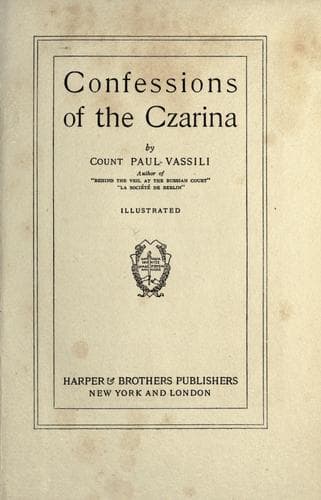
Confessions of the CzarinaRadziwill, Catherine, Princess
History
Confessions of the Czarina
Radziwill, Catherine, Princess
Alexandra, Empress, consort of Nicholas II, Emperor of Russia, 1872-1918; Russia -- Court and courtiers
It is time here to say a word concerning Mr. Sturmer, who was so soon to
play a prominent part in the drama of the Romanoffs’ fate. He was a man
of moderate intelligence, great ambition, and above everything else an
opportunist--a perfect type of the class called in Russian Tchinownikis,
who always and in everything it does approves the government of the day.
He had for years paraded ultra-conservative opinions, and while he had
performed the functions of Master of the Ceremonies at the Imperial
Court, he had professed great sympathies for England and for everything
British, playing the European, while at heart he was the personification
of the Tartar hidden under the Russian flag. He was, moreover, an
excellent talker and a well-read, well-educated man. His German origin
had imbued him, as was to be expected, with considerable admiration for
the Kultur, such as it was understood at the time I am referring to. The
late Czar Alexander III. had always abominated him and shown him that
such was the case in an unmistakable manner. But Mr. Sturmer had the
happy knack never to notice what it was inconvenient for him to be
caught looking at; he stuck to his post until he contrived to get
another appointment, that of President of the zemstwo of the province of
Twer, where he possessed a large estate. This position, however, he had
to abandon soon, because his colleagues happened all of them to be very
ardent liberals who refused to accept his monarchical views.
Sturmer retired to private life, but at the time of the accession to the
Throne of Nicholas II. he came to St. Petersburg, and managed to convey
to the new Czar a detailed report as to the wave of liberalism that, to
use his words, “infected” the province of Twer. If we are to believe a
rumor which was persistently circulated in the capital, this had a good
deal to do with the famous speech in which the Emperor told the deputies
of the zemstwos (come to congratulate him on his marriage) that they
need not in the future indulge in “senseless dreams,” as it was his firm
intention to uphold intact the principles of autocracy.
Public-domain text, read in full here on John Shaqi.
Reviews
Reviews
No reviews yet
Be the first to share your thoughts on this work.
Elsewhere in the archive
Join the Discussion
Join the discussion
Sign in to leave a comment or review.
Sign InorCreate an account