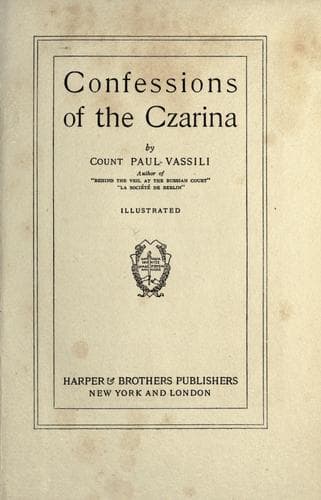
Confessions of the CzarinaRadziwill, Catherine, Princess
History
Confessions of the Czarina
Radziwill, Catherine, Princess
Alexandra, Empress, consort of Nicholas II, Emperor of Russia, 1872-1918; Russia -- Court and courtiers
I wish to explain how it could have become possible for her to be
transformed into an active agent of German ambition on the Russian
Throne. She was, as we have seen, only half-responsible for her actions.
Her intelligence had never been properly balanced and self-control had
never been taught her. She had, however, principles, and very strong
ones, too, which had stood between her and temptation in the serious
sentimental crisis of her life. But this resistance to what perhaps had
been the one passion she had known, except her love for her son, had
helped to overthrow her mental balance. She had given to God,
represented by a Divinity of her own created by her imagination, all the
affection she had not been allowed to expend on earth, and full of a
spirit of self-sacrifice as stupid as it was devoid of any ground to
stand upon. She had fancied that she could work out her personal
salvation, together with that of her family and subjects, in restoring
to the country whose Empress she happened to be the blessings of a peace
that would stop the effusion of blood the thought of which robbed her of
sleep at night and repose by day.
She was living in a state which most certainly was bordering on
insanity, and she had entirely lost the faculty of discriminating
between what was reality and what was a dream. Raspoutine held her in a
kind of trance, which was further aggravated by the long fasts to which
he obliged her to submit. She was told that she was the victim chosen by
the Almighty to expiate all the sins of the Russian Empire, that it was
only through constant prayer, combined with all kinds of other
mortifications, that she could hope to see restored the peace of her
mind and the health of her son. It is probable that she suffered from
hallucinations during which she saw, as in a cloud, the rising shapes of
soldiers killed in battle, clamoring to her to stop the useless
massacres going on in the Polish plains where they had fallen. Is it a
wonder that, unconscious of aught else than this condition of
self-reproach to which she had been reduced, she tried to end her own
sufferings, as well as the misery which had fallen upon her country, by
disregarding all the advice she received from her real friends and
making the most frantic efforts to induce her husband to accept the
peace terms which the Kaiser had more than once caused to be secretly
conveyed to him?
Nicholas II. was also weary of the struggle, but he realized better than
his wife the impossibility which existed for him of acting independently
of his Allies. He had Ministers who, in spite of their respect for his
person and authority, would not have hesitated to point out to him the
grave consequences which a defection of Russia would mean for the whole
cause of the Allied nations, who, after all, had been entangled in this
disastrous war because they had rushed to his help and to that of his
people.
Public-domain text, read in full here on John Shaqi.
Reviews
Reviews
No reviews yet
Be the first to share your thoughts on this work.
Elsewhere in the archive
Join the Discussion
Join the discussion
Sign in to leave a comment or review.
Sign InorCreate an account