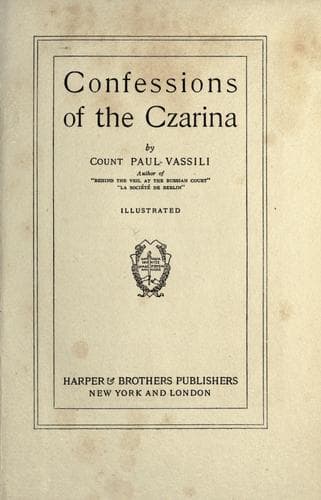
Confessions of the CzarinaRadziwill, Catherine, Princess
History
Confessions of the Czarina
Radziwill, Catherine, Princess
Alexandra, Empress, consort of Nicholas II, Emperor of Russia, 1872-1918; Russia -- Court and courtiers
When the outsider tries to form an opinion as to all the events which
preceded the rebellion that destroyed the Throne of the Romanoffs, it is
essential he should remember the state of mind of the Czarina at this
particular time, as well as the condition of her nerves--a condition
which was very nearly akin to the one into which a man falls when, after
having been the victim of a pernicious drug habit, he finds himself
unexpectedly and suddenly deprived of his favorite morphia or cocaine.
The Empress had been living for months under the influence of these
mysterious night sittings during which Raspoutine evoked for her, as she
firmly believed, spirits of another world from whom she sought
inspiration and in whom she found comfort. All at once this moral aid,
which had helped her to live, was denied to her, and she did not know
any longer what she was to do, surrounded as she felt herself to be by
ever-increasing dangers which threatened not only her own person, but
that of her beloved child, that son in whom she firmly believed Russia
would find its salvation and who was destined to become one of the
greatest and mightiest Sovereigns the country had ever seen reign over
it since the days of Peter the Great. She felt absolutely at sea, like a
ship deprived of its pilot and abandoned to inexperienced hands,
ignorant of the first principles of navigation. Neither her husband,
whom at heart she despised, nor her friend, Anna Wyrubewa, whom she had
never entirely initiated into all the details of her secret intercourse
with the dead, nor her faithful advisers, Sturmer and Protopopoff, could
make up to her for the irreparable loss of the companionship which,
thanks to Raspoutine, she believed she had succeeded in establishing
between herself and the soul of the only man she had ever truly loved.
It is only after having grasped these essential facts in the life of the
misguided Empress of Russia that it is possible to come to a reasonable
appreciation of her person, character, and intrigues.
Once this has been done, it becomes relatively easy to understand the
influence which Raspoutine had acquired over her mind, and not to share
the general opinion that there existed something immoral in her
relations with him. Immorality alone could not explain this entire
submission on the part of a cultured, well-educated, elegant woman to
the will of a dirty, uncouth, ignorant peasant. Besides that, Alexandra
Feodorowna was far too proud to forget for one moment the social
difference which separated her from the “Prophet.” In her intercourse
with him she remained the Empress, and on his side he was far too shrewd
not to remember it also. He knew very well that one indiscreet word, one
imprudent gesture, would have put an end at once to his influence, and
the man as well as his accomplices were working for far too great and
far too important an object to compromise its success by anything which
might have savored of immoral intrigue.
Public-domain text, read in full here on John Shaqi.
Reviews
Reviews
No reviews yet
Be the first to share your thoughts on this work.
Elsewhere in the archive
Join the Discussion
Join the discussion
Sign in to leave a comment or review.
Sign InorCreate an account