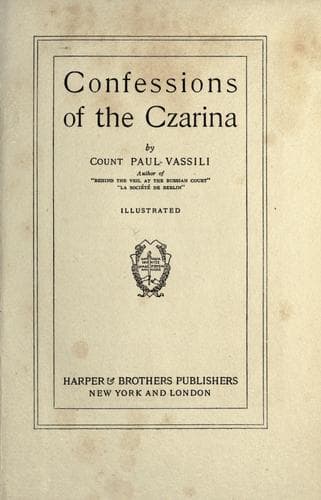
Confessions of the CzarinaRadziwill, Catherine, Princess
History
Confessions of the Czarina
Radziwill, Catherine, Princess
Alexandra, Empress, consort of Nicholas II, Emperor of Russia, 1872-1918; Russia -- Court and courtiers
Whether Anna Wyrubewa was sincere or not in thus pleading a cause which
she knew her Imperial mistress had but too much at heart even without
her interference, I shall not attempt to guess. Russia was most
certainly going through a terrible crisis, and those who thought that
the quick conclusion of a peace after which so many were secretly
longing and sighing was indispensable were by no means a small minority
in the country. It is quite likely that the Empress’s confidante was
sincere in her conduct, and it seems pretty certain that she had no
pecuniary or material advantages in view when she lent herself to the
dangerous scheme suggested to her by Sturmer and the latter’s
accomplices. _They_ were not disinterested; they had decidedly ambitious
views as to their own future, and they were most certainly in the employ
of Germany, to which they had promised their co-operation. Protopopoff
was a man who, in regard to the large fortune he was credited with
possessing, was entirely self-made; he had never shown any hesitation as
to the choice of the means by which he had acquired it. Sturmer thought
himself endowed with the genius of a Bismarck or of a Richelieu, and
dreamed of the glory of a peace that would leave Russia in appearance as
strong as ever, but united by the closest of ties to the German Empire,
of which he had been all through his political career a devoted admirer
and servant. He had always preached the necessity of the renewal of the
former alliance that in bygone times had united the Hohenzollerns and
the Romanoffs. His vanity felt deeply flattered upon hearing from his
friends in Berlin that the Kaiser, as well as the latter’s Government,
considered him the one great Minister Russia had ever possessed and were
looking up to him to heal all the evils and all the miseries which the
war had brought about. He did not care for the treaties that had been
signed between Russia and her Allies, and probably shared the opinion of
Mr. von Bethmann-Hollweg that all such documents were nothing but scraps
of paper, not worthy of any notice on the part of intelligent people. He
cared only for success, for titles, decorations, power, and a crowd of
flatterers about him. Russia had ceased to be for him a matter for
consideration. She would always fare well, in his opinion, if only he
were allowed to direct her destinies. The war itself, with all the
terrible breakage it had brought about, did not trouble him. It had
begun with broken treaties and broken faith, broken honor and broken
word; its result had been broken houses in broken lands, broken men, and
broken hearts, but about these last Mr. Sturmer did not think at all.
Public-domain text, read in full here on John Shaqi.
Reviews
Reviews
No reviews yet
Be the first to share your thoughts on this work.
Elsewhere in the archive
Join the Discussion
Join the discussion
Sign in to leave a comment or review.
Sign InorCreate an account