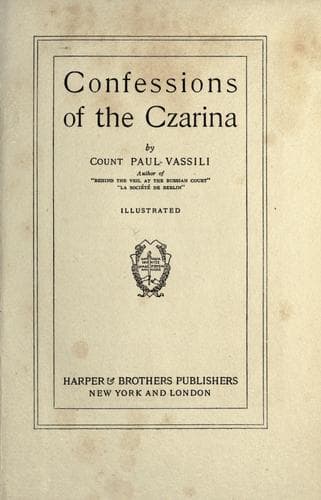
Confessions of the CzarinaRadziwill, Catherine, Princess
History
Confessions of the Czarina
Radziwill, Catherine, Princess
Alexandra, Empress, consort of Nicholas II, Emperor of Russia, 1872-1918; Russia -- Court and courtiers
When the Czar left Tsarskoye Selo--for the last time, as it turned out,
as a powerful, dreaded Sovereign--the Empress had not yet made up her
mind as to what she ought to do. She was being urged by Sturmer and
Protopopoff to come to a decision in regard to the future of the
dynasty, which they declared to her was entirely in her hands; at the
same time she lacked the moral courage to put herself boldly at the head
of a movement to dethrone her husband. She had not the audacity of
Catherine the Great, nor the latter’s unscrupulousness, and, moreover,
her mind was so weakened by the superstitious practices in which she had
become absorbed that it is to be questioned whether or not she was given
a true account of what was going on around her. She was entirely at the
mercy of the first determined man who came along, audacious enough to
compel her to sing according to his tune. But neither Sturmer nor
Protopopoff were clever enough to be that. And they had no political
party on whom they could rely to help them execute any plans they might
form. They depended for their inspiration on the directions which they
received from Berlin. By a lucky accident this inspiration failed them
at the very moment they most needed it.
What had happened was this: The Allies had begun to get some inkling as
to the intrigue which was going on under the Czar’s own roof, an
intrigue in which his wife held the foremost rôle. They contrived to put
obstacles in the way of Mr. Protopopoff and of his friends, and to stop
for a while the active correspondence which he was carrying on with the
German Government _via_ Stockholm. At the same time they arranged
matters in such a way that the liberal leaders in the Duma became
apprised of the negotiations pending between the Kaiser and his
kinswoman at Tsarskoye Selo.
The story of the eventful days which preceded the Revolution have
nothing to do with the present book, and I shall refer to them only in
so far as they concern the Empress. She was mostly responsible for the
rapidity with which rebellion spread and for the unexpected way in which
it broke out. Had she remained quiet, it is likely that things might
have dragged on for a few weeks, perhaps even for a few months, longer,
because no one at this particular moment cared to see a change in the
Government. But when it was ascertained that she had become a danger to
the nation in general there was no longer any question of a delay, and
events had to be forced on in some way or other.
Public-domain text, read in full here on John Shaqi.
Reviews
Reviews
No reviews yet
Be the first to share your thoughts on this work.
Elsewhere in the archive
Join the Discussion
Join the discussion
Sign in to leave a comment or review.
Sign InorCreate an account