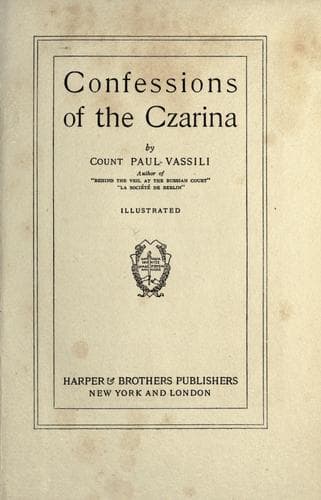
Confessions of the CzarinaRadziwill, Catherine, Princess
History
Confessions of the Czarina
Radziwill, Catherine, Princess
Alexandra, Empress, consort of Nicholas II, Emperor of Russia, 1872-1918; Russia -- Court and courtiers
In the mean time the Emperor remained at the front, and if we are to
believe all that was subsequently related about his conduct there, he
changed considerably his opinion and point of view after having resumed
direct contact with his troops. He convinced himself that they were not
at all as anxious for peace as he had been led to expect, and that the
feelings of the men in regard to Germany were revengeful more than
anything else. His generals, and especially Aléxieieff, who was Head of
the Staff, kept urging upon him the necessity of preparing a formidable
offensive, this time on the Riga front. The General gave him hopes that
it would turn out to be a successful one, provided (and this was the one
everlasting and burning question) that the War Office sent sufficient
ammunition to the front. The Emperor was persuaded that this could be
done, but Aléxieieff was not so sanguine, and he started a private
inquiry of his own as to what was going on in Petrograd in that respect.
The result of it was that he was convinced that the Ministry had lately
completely neglected this important item and had spent its time in
arresting workmen whom it suspected of harboring democratic opinions, as
well as in curtailing the hours of labor at the different factories
where ammunition was manufactured. Protopopoff wanted the war to end,
and he hoped that in limiting the output of shells and guns he would be
able to place the country in such a position that a cessation of
hostilities would become unavoidable.
A report to the Emperor, in which the situation such as it presented
itself was exposed with great details, was brought to him by the Staff.
As usual, it left him unmoved. He merely said that he would give orders
to the War Office to take henceforward its orders from the
Commander-in-chief of the Armies in the Field, meaning himself, but he
refused to blame Protopopoff or to hear anything concerning the
appointment of a liberal and responsible Cabinet from whom the Duma
could require accounts. He did not mean to lessen his own prerogatives
by the merest fraction, and he still thought that Russia might hold its
own against her formidable foes without arms, provisions, shells, or big
guns, and in general without means of defense capable of stopping the
progress of the invaders in their triumphal march through his Empire.
Public-domain text, read in full here on John Shaqi.
Reviews
Reviews
No reviews yet
Be the first to share your thoughts on this work.
Elsewhere in the archive
Join the Discussion
Join the discussion
Sign in to leave a comment or review.
Sign InorCreate an account