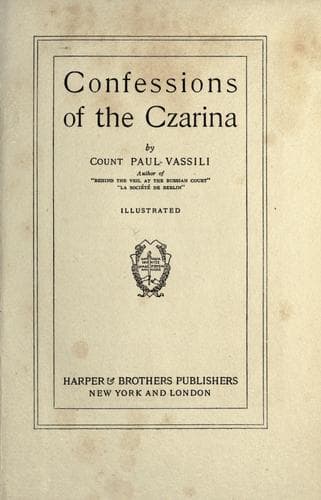
Confessions of the CzarinaRadziwill, Catherine, Princess
History
Confessions of the Czarina
Radziwill, Catherine, Princess
Alexandra, Empress, consort of Nicholas II, Emperor of Russia, 1872-1918; Russia -- Court and courtiers
Though the hour of the departure of Nicholas had been kept as secret as
possible, the whole town of Tsarskoye Selo knew that he was about to
leave it forever. The population for once was awed before the immensity
of the disaster. One was used in Russia to people being sent to Siberia;
one had seen a Menschikoff, a Biren, a Dolgorouky, and more recently a
Prince Troubetskoy, and a Mourawieff-Apostol, start on this dreaded
journey whence so few ever returned. But here was something different.
Here was a Romanoff about to go there where his ancestors and himself
had deported so many, so many, entirely innocent people. Here was the
dreaded Sovereign, whose name had been for such a long time mentioned
only with reverence and with fear, exiled like one of those persons whom
he had sent to Siberia with a mere stroke of his pen. Here was Nicholas
II., formerly Emperor and Autocrat of All the Russias, here was the
mighty Czar who had been crowned at Moscow, reduced to the condition of
a common criminal by the subjects whose rights he had violated, whose
consciences he had trampled upon, whose liberty he had taken away, and
whose lives he had in so many instances tried to destroy. Truly the
sight was appalling, and there were but few among those who in the early
twilight of a summer morning looked at that mournful train which was
carrying away toward the distant north so much dead grandeur and such
awful misfortune, there were but few who did not realize that they were
witnessing something more tragic and more solemn even than a funeral,
that they were looking upon the end of a great chapter in Russian
history, and that it was not only a Czar who lay buried under all these
ruins, but also something of the past glories of the country.
They had been, after all, together with the future of the Romanoff
dynasty, a great race that had produced great men and they deserved to
have, as their last crowned descendant, some one better than Nicholas
II. had proved to be. They had often been cruel, more frequently even
unjust; they had never respected what the world is used to venerate and
to esteem; they had shown themselves hard in regard to their subjects;
but they had made out of dark, ignorant Russia an immense Empire on
which even more immense hopes had been built. They had exercised on
several occasions a restraining influence over the exaggerations of
half-educated and half-instructed men with all the instincts of the
savage and but few of the qualities of the civilized being. They had led
their people through danger, through war, through many momentous days of
rejoicing as well as of anguish. They had been a part of the Russian
nation, and with their disgrace and fall something in that nation, too,
had been dishonored and had perished.
Public-domain text, read in full here on John Shaqi.
Reviews
Reviews
No reviews yet
Be the first to share your thoughts on this work.
Elsewhere in the archive
Join the Discussion
Join the discussion
Sign in to leave a comment or review.
Sign InorCreate an account