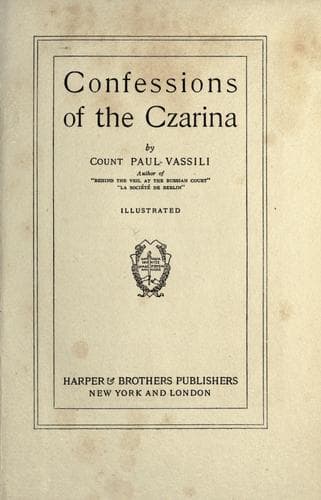
Confessions of the CzarinaRadziwill, Catherine, Princess
History
Confessions of the Czarina
Radziwill, Catherine, Princess
Alexandra, Empress, consort of Nicholas II, Emperor of Russia, 1872-1918; Russia -- Court and courtiers
Raspoutine was a keen observer of human nature. Lurking behind his
hopeless ignorance there were immense cunning and a natural intuition of
what was going on in other people’s minds. Apart from this faculty, he
always made it a point to try and find out as much as he could
concerning the past of all persons with whom he happened to have
dealings. He understood quite admirably the art of “drawing out” those
with whom he conversed, and he could put together quite nicely the
tangled threads which another man would never have gone to the trouble
of trying to untwine. As soon as he had looked upon the Empress he had
understood that she must have gone through some great grief which was
not concerned with the state of health of her child alone, but which had
deeper foundations. In the fashionable drawing-rooms where he was a
welcome guest he had heard discussed more than once the personality as
well as the conduct of Alexandra Feodorowna; he had come to the
conclusion that the mystery which surrounded the death of Colonel Orloff
was in some way connected with her, and not with Madame Wyrubewa alone.
He applied himself, therefore, to discover what had really taken place.
For some time he could learn nothing, as no one seemed to know anything
more than the bare fact of the suicide of the young officer. It is true
that when he had asked Anna for the true version the latter had angrily
denied any connection implying guilt, but Raspoutine, peasant though he
was, understood sufficiently the character of a woman of the world to
know that such denials were not worth much. Altogether he was puzzled,
but continued, however, to put in an appearance at Tsarskoye Selo
whenever he was asked to do so, and he was shown several times the
little Heir to the Throne. The Empress had brought the babe to Madame
Wyrubewa’s cottage several times for him to pray over. The “Prophet” had
at once declared that the child would not die, and that there was every
likelihood he would outgrow his weakness, a prophecy it had been
relatively easy for him to make, considering the fact that before doing
so he had taken good care to talk with a doctor of his acquaintance
about the illness of Alexis, and had heard from him all that there was
to hear on the subject, which was not much. The boy might live with
care, and even get strong, once he had reached the years of adolescence;
he might die from the effect of a hemorrhage, which the slightest
accident might bring about. The whole thing was a matter of chance, and
nothing else.
Public-domain text, read in full here on John Shaqi.
Reviews
Reviews
No reviews yet
Be the first to share your thoughts on this work.
Elsewhere in the archive
Join the Discussion
Join the discussion
Sign in to leave a comment or review.
Sign InorCreate an account