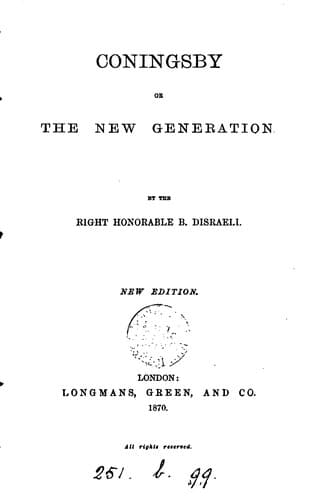
Coningsby; Or, The New GenerationDisraeli, Benjamin, Earl of Beaconsfield
General
Coningsby; Or, The New Generation
Disraeli, Benjamin, Earl of Beaconsfield
Great Britain -- Fiction; Political fiction; Politicians -- Fiction
‘Manners are easy,’ said Coningsby, ‘and life is hard.’
‘And I wish to see things exactly the reverse,’ said Lord Henry. ‘The
means and modes of subsistence less difficult; the conduct of life more
ceremonious.’
‘Civilisation has no time for ceremony,’ said Lord Everingham.
‘How very sententious you all are!’ said his wife. ‘I want to see the
hall and many other things.’ And they all rose.
There were indeed many other things to see: a long gallery, rich in
ancestral portraits, specimens of art and costume from Holbein to
Lawrence; courtiers of the Tudors, and cavaliers of the Stuarts,
terminating in red-coated squires fresh from the field, and gentlemen
buttoned up in black coats, and sitting in library chairs, with their
backs to a crimson curtain. Woman, however, is always charming; and the
present generation may view their mothers painted by Lawrence, as if
they were patronesses of Almack’s; or their grandmothers by Reynolds,
as Robinettas caressing birds, with as much delight as they gaze on
the dewy-eyed matrons of Lely, and the proud bearing of the heroines
of Vandyke. But what interested them more than the gallery, or the rich
saloons, or even the baronial hall, was the chapel, in which art had
exhausted all its invention, and wealth offered all its resources.
The walls and vaulted roofs entirely painted in encaustic by the first
artists of Germany, and representing the principal events of the second
Testament, the splendour of the mosaic pavement, the richness of
the painted windows, the sumptuousness of the altar, crowned by a
masterpiece of Carlo Dolce and surrounded by a silver rail, the tone
of rich and solemn light that pervaded all, and blended all the various
sources of beauty into one absorbing and harmonious whole: all combined
to produce an effect which stilled them into a silence that lasted for
some minutes, until the ladies breathed their feelings in an almost
inarticulate murmur of reverence and admiration; while a tear stole to
the eye of the enthusiastic Henry Sydney.
Leaving the chapel, they sauntered through the gardens, until, arriving
at their limit, they were met by the prettiest sight in the world; a
group of little pony chairs, each drawn by a little fat fawn-coloured
pony, like the one that Mr. Lyle had been riding. Lord Henry drove his
mother; Lord Everingham, Lady Theresa; Lady Everingham was attended by
Coningsby. Their host cantered by the Duchess’s side, and along winding
roads of easy ascent, leading through beautiful woods, and offering
charming landscapes, they reached in due time the Upper Park.
‘One sees our host to great advantage in his own house,’ said Lady
Everingham. ‘He is scarcely the same person. I have not observed him
once blush. He speaks and moves with ease. It is a pity that he is not
more graceful. Above all things I like a graceful man.’
‘That chapel,’ said Coningsby, ‘was a fine thing.’
Public-domain text, read in full here on John Shaqi.
Reviews
Reviews
No reviews yet
Be the first to share your thoughts on this work.
Elsewhere in the archive
Join the Discussion
Join the discussion
Sign in to leave a comment or review.
Sign InorCreate an account