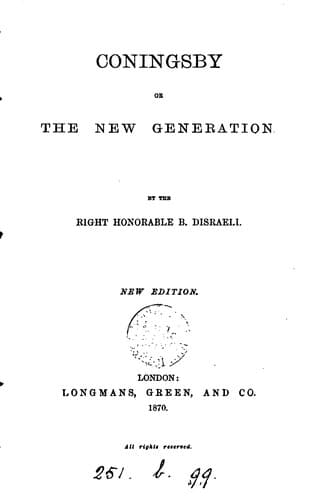
Coningsby; Or, The New GenerationDisraeli, Benjamin, Earl of Beaconsfield
General
Coningsby; Or, The New Generation
Disraeli, Benjamin, Earl of Beaconsfield
Great Britain -- Fiction; Political fiction; Politicians -- Fiction
For Coningsby, not only the chief of his house, but his host too. In
either capacity he ought to address Lord Monmouth. To sit down to dinner
without having previously paid his respects to his grandfather, to whom
he was so much indebted, and whom he had not seen for so many years,
struck him not only as uncourtly, but as unkind and ungrateful, and,
indeed, in the highest degree absurd. But how was he to do it? Lord
Monmouth seemed deeply engaged, and apparently with some very great
lady. And if Coningsby advanced and bowed, in all probability he would
only get a bow in return. He remembered the bow of his first interview.
It had made a lasting impression on his mind. For it was more than
likely Lord Monmouth would not recognise him. Four years had not
sensibly altered Lord Monmouth, but four years had changed Harry
Coningsby from a schoolboy into a man. Then how was he to make himself
known to his grandfather? To announce himself as Coningsby, as his
Lordship’s grandson, seemed somewhat ridiculous: to address his
grandfather as Lord Monmouth would serve no purpose: to style Lord
Monmouth ‘grandfather’ would make every one laugh, and seem stiff and
unnatural. What was he to do? To fall into an attitude and exclaim,
‘Behold your grandchild!’ or, ‘Have you forgotten your Harry?’
Even to catch Lord Monmouth’s glance was not an easy affair; he was
much occupied on one side by the great lady, on the other were several
gentlemen who occasionally joined in the conversation. But something
must be done.
There ran through Coningsby’s character, as we have before mentioned, a
vein of simplicity which was not its least charm. It resulted, no doubt,
in a great degree from the earnestness of his nature. There never was a
boy so totally devoid of affectation, which was remarkable, for he had a
brilliant imagination, a quality that, from its fantasies, and the
vague and indefinite desires it engenders, generally makes those whose
characters are not formed, affected. The Duchess, who was a fine judge
of character, and who greatly regarded Coningsby, often mentioned this
trait as one which, combined with his great abilities and acquirements
so unusual at his age, rendered him very interesting. In the present
instance it happened that, while Coningsby was watching his grandfather,
he observed a gentleman advance, make his bow, say and receive a few
words and retire. This little incident, however, made a momentary
diversion in the immediate circle of Lord Monmouth, and before they
could all resume their former talk and fall into their previous
positions, an impulse sent forth Coningsby, who walked up to Lord
Monmouth, and standing before him, said,
‘How do you do, grandpapa?’
Public-domain text, read in full here on John Shaqi.
Reviews
Reviews
No reviews yet
Be the first to share your thoughts on this work.
Elsewhere in the archive
Join the Discussion
Join the discussion
Sign in to leave a comment or review.
Sign InorCreate an account