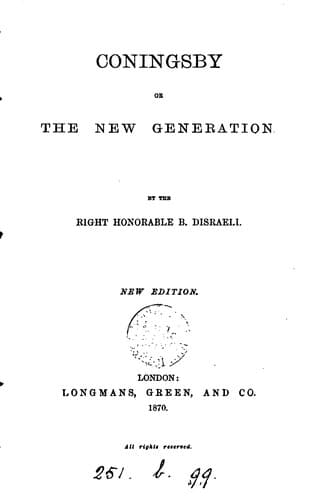
Coningsby; Or, The New GenerationDisraeli, Benjamin, Earl of Beaconsfield
General
Coningsby; Or, The New Generation
Disraeli, Benjamin, Earl of Beaconsfield
Great Britain -- Fiction; Political fiction; Politicians -- Fiction
But all this time Villebecque was dancing on a volcano. The catastrophe
which inevitably occurs in the career of all great speculators, and
especially theatrical ones, arrived to him. Flushed with his prosperity,
and confident in his constant success, nothing would satisfy him
but universal empire. He had established his despotism at Paris, his
dynasties at Naples and at Milan; but the North was not to him, and
he was determined to appropriate it. Berlin fell before a successful
campaign, though a costly one; but St. Petersburg and London still
remained. Resolute and reckless, nothing deterred Villebecque. One
season all the opera-houses in Europe obeyed his nod, and at the end
of it he was ruined. The crash was utter, universal, overwhelming; and
under ordinary circumstances a French bed and a brasier of charcoal
alone remained for Villebecque, who was equal to the occasion. But
the thought of La Petite and the remembrance of his promise to Stella
deterred him from the deed. He reviewed his position in a spirit
becoming a practical philosopher. Was he worse off than before he
commenced his career? Yes, because he was older; though to be sure he
had his compensating reminiscences. But was he too old to do anything?
At forty-five the game was not altogether up; and in a large theatre,
not too much lighted, and with the artifices of a dramatic toilet,
he might still be able successfully to reassume those characters of
coxcombs and muscadins, in which he was once so celebrated. Luxury had
perhaps a little too much enlarged his waist, but diet and rehearsals
would set all right.
Villebecque in their adversity broke to La Petite, that the time had
unfortunately arrived when it would be wise for her to consider the most
effectual means for turning her talents and accomplishments to account.
He himself suggested the stage, to which otherwise there were
doubtless objections, because her occupation in any other pursuit would
necessarily separate them; but he impartially placed before her the
relative advantages and disadvantages of every course which seemed to
lie open to them, and left the preferable one to her own decision. La
Petite, who had wept very much over Villebecque’s misfortunes, and often
assured him that she cared for them only for his sake, decided for the
stage, solely because it would secure their not being parted; and yet,
as she often assured him, she feared she had no predisposition for the
career.
Public-domain text, read in full here on John Shaqi.
Reviews
Reviews
No reviews yet
Be the first to share your thoughts on this work.
Elsewhere in the archive
Join the Discussion
Join the discussion
Sign in to leave a comment or review.
Sign InorCreate an account