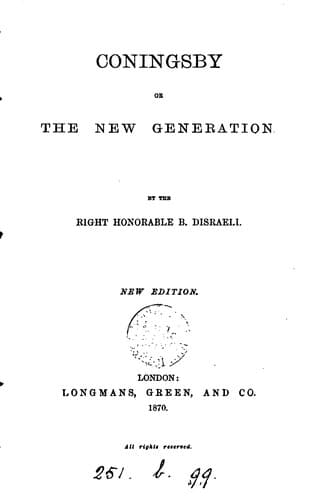
Coningsby; Or, The New GenerationDisraeli, Benjamin, Earl of Beaconsfield
General
Coningsby; Or, The New Generation
Disraeli, Benjamin, Earl of Beaconsfield
Great Britain -- Fiction; Political fiction; Politicians -- Fiction
Whence came those Mosaic Arabs whose passages across the strait from
Africa to Europe long preceded the invasion of the Mohammedan Arabs, it
is now impossible to ascertain. Their traditions tell us that from time
immemorial they had sojourned in Africa; and it is not improbable that
they may have been the descendants of some of the earlier dispersions;
like those Hebrew colonies that we find in China, and who probably
emigrated from Persia in the days of the great monarchies. Whatever may
have been their origin in Africa, their fortunes in Southern Europe
are not difficult to trace, though the annals of no race in any age can
detail a history of such strange vicissitudes, or one rife with more
touching and romantic incident. Their unexampled prosperity in the
Spanish Peninsula, and especially in the south, where they had become
the principal cultivators of the soil, excited the jealousy of the
Goths; and the Councils of Toledo during the sixth and seventh
centuries attempted, by a series of decrees worthy of the barbarians who
promulgated them, to root the Jewish Arabs out of the land. There is no
doubt the Council of Toledo led, as directly as the lust of Roderick,
to the invasion of Spain by the Moslemin Arabs. The Jewish population,
suffering under the most sanguinary and atrocious persecution, looked to
their sympathising brethren of the Crescent, whose camps already gleamed
on the opposite shore. The overthrow of the Gothic kingdoms was as much
achieved by the superior information which the Saracens received from
their suffering kinsmen, as by the resistless valour of the Desert. The
Saracen kingdoms were established. That fair and unrivalled civilisation
arose which preserved for Europe arts and letters when Christendom was
plunged in darkness. The children of Ishmael rewarded the children of
Israel with equal rights and privileges with themselves. During these
halcyon centuries, it is difficult to distinguish the follower of Moses
from the votary of Mahomet. Both alike built palaces, gardens, and
fountains; filled equally the highest offices of the state, competed
in an extensive and enlightened commerce, and rivalled each other in
renowned universities.
Public-domain text, read in full here on John Shaqi.
Reviews
Reviews
No reviews yet
Be the first to share your thoughts on this work.
Elsewhere in the archive
Join the Discussion
Join the discussion
Sign in to leave a comment or review.
Sign InorCreate an account