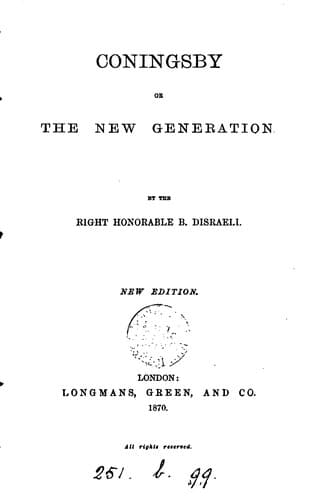
Coningsby; Or, The New GenerationDisraeli, Benjamin, Earl of Beaconsfield
General
Coningsby; Or, The New Generation
Disraeli, Benjamin, Earl of Beaconsfield
Great Britain -- Fiction; Political fiction; Politicians -- Fiction
It is not difficult to conceive that, after having pursued the career we
have intimated for about ten years, Sidonia had become one of the most
considerable personages in Europe. He had established a brother, or
a near relative, in whom he could confide, in most of the principal
capitals. He was lord and master of the money-market of the world, and
of course virtually lord and master of everything else. He literally
held the revenues of Southern Italy in pawn; and monarchs and ministers
of all countries courted his advice and were guided by his suggestions.
He was still in the vigour of life, and was not a mere money-making
machine. He had a general intelligence equal to his position, and looked
forward to the period when some relaxation from his vast enterprises and
exertions might enable him to direct his energies to great objects of
public benefit. But in the height of his vast prosperity he suddenly
died, leaving only one child, a youth still of tender years, and heir to
the greatest fortune in Europe, so great, indeed, that it could only be
calculated by millions.
Shut out from universities and schools, those universities and schools
which were indebted for their first knowledge of ancient philosophy
to the learning and enterprise of his ancestors, the young Sidonia was
fortunate in the tutor whom his father had procured for him, and who
devoted to his charge all the resources of his trained intellect and
vast and varied erudition. A Jesuit before the revolution; since then an
exiled Liberal leader; now a member of the Spanish Cortes; Rebello
was always a Jew. He found in his pupil that precocity of intellectual
development which is characteristic of the Arabian organisation. The
young Sidonia penetrated the highest mysteries of mathematics with
a facility almost instinctive; while a memory, which never had any
twilight hours, but always reflected a noontide clearness, seemed to
magnify his acquisitions of ancient learning by the promptness with
which they could be reproduced and applied.
The circumstances of his position, too, had early contributed to give
him an unusual command over the modern languages. An Englishman, and
taught from his cradle to be proud of being an Englishman, he first
evinced in speaking his native language those remarkable powers of
expression, and that clear and happy elocution, which ever afterwards
distinguished him. But the son of a Spaniard, the sonorous syllables
of that noble tongue constantly resounded in his ear; while the foreign
guests who thronged his father’s mansion habituated him from an early
period of life to the tones of languages that were not long strange to
him. When he was nineteen, Sidonia, who had then resided some time
with his uncle at Naples, and had made a long visit to another of his
father’s relatives at Frankfort, possessed a complete mastery over the
principal European languages.
Public-domain text, read in full here on John Shaqi.
Reviews
Reviews
No reviews yet
Be the first to share your thoughts on this work.
Elsewhere in the archive
Join the Discussion
Join the discussion
Sign in to leave a comment or review.
Sign InorCreate an account