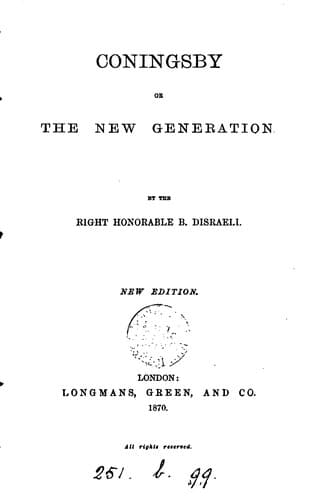
Coningsby; Or, The New GenerationDisraeli, Benjamin, Earl of Beaconsfield
General
Coningsby; Or, The New Generation
Disraeli, Benjamin, Earl of Beaconsfield
Great Britain -- Fiction; Political fiction; Politicians -- Fiction
‘What and why?’ she replied.
‘The mission is to entreat you to do us all a great favour; and the
cause of its failure will be that I am the envoy.’
‘If the favour be one to yourself, it is granted; and if you be the
envoy, you need never fear failure with me.’
‘I must presume then to lead you away,’ said Coningsby, bending to the
Ambassador.
‘Remember,’ said Lucretia, as they approached the instrument, ‘that I am
singing to you.’
‘It is impossible ever to forget it,’ said Coningsby, leading her to the
piano with great politeness, but only with great politeness.
‘Where is Mademoiselle Flora?’ she inquired.
Coningsby found La Petite crouching as it were behind some furniture,
and apparently looking over some music. She looked up as he approached,
and a smile stole over her countenance. ‘I am come to ask a favour,’ he
said, and he named his request.
‘I will sing,’ she replied; ‘but only tell me what you like.’
Coningsby felt the difference between the courtesy of the head and of
the heart, as he contrasted the manner of Lucretia and Flora. Nothing
could be more exquisitely gracious than the daughter of Colonna was
to-night; Flora, on the contrary, was rather agitated and embarrassed;
and did not express her readiness with half the facility and the grace
of Lucretia; but Flora’s arm trembled as Coningsby led her to the piano.
Meantime Lord Eskdale and Sidonia are in deep converse.
‘Hah! that is a fine note!’ said Sidonia, and he looked round. ‘Who is
that singing? Some new _protégée_ of Lord Monmouth?’
‘’Tis the daughter of the Colonnas,’ said Lord Eskdale, ‘the Princess
Lucretia.’
‘Why, she was not at dinner to-day.’
‘No, she was not there.’
‘My favourite voice; and of all, the rarest to be found. When I was a
boy, it made me almost in love even with Pisaroni.’
‘Well, the Princess is scarcely more lovely. ‘Tis a pity the plumage is
not as beautiful as the note. She is plain.’
‘No; not plain with that brow.’
‘Well, I rather admire her myself,’ said Lord Eskdale. ‘She has fine
points.’
‘Let us approach,’ said Sidonia.
The song ceased, Lord Eskdale advanced, made his compliments, and then
said, ‘You were not at dinner to-day.’
‘Why should I be?’ said the Princess.
‘For our sakes, for mine, if not for your own,’ said Lord Eskdale,
smiling. ‘Your absence has been remarked, and felt, I assure you, by
others as well as myself. There is my friend Sidonia so enraptured with
your thrilling tones, that he has abruptly closed a conversation which I
have been long counting on. Do you know him? May I present him to you?’
And having obtained a consent, not often conceded, Lord Eskdale looked
round, and calling Sidonia, he presented his friend to the Princess.
‘You are fond of music, Lord Eskdale tells me?’ said Lucretia.
‘When it is excellent,’ said Sidonia.
‘But that is so rare,’ said the Princess.
‘And precious as Paradise,’ said Sidonia. ‘As for indifferent music,
‘tis Purgatory; but when it is bad, for my part I feel myself--’
Public-domain text, read in full here on John Shaqi.
Reviews
Reviews
No reviews yet
Be the first to share your thoughts on this work.
Elsewhere in the archive
Join the Discussion
Join the discussion
Sign in to leave a comment or review.
Sign InorCreate an account