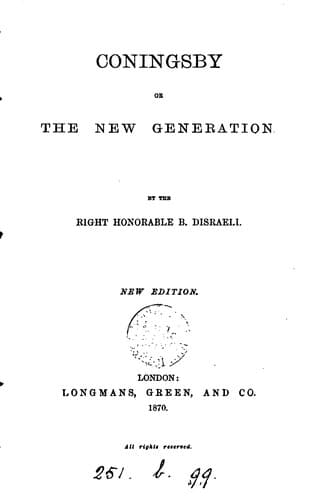
Coningsby; Or, The New GenerationDisraeli, Benjamin, Earl of Beaconsfield
General
Coningsby; Or, The New Generation
Disraeli, Benjamin, Earl of Beaconsfield
Great Britain -- Fiction; Political fiction; Politicians -- Fiction
while, on the other hand, she was not only anxious, but resolved, not
to delay on her part her emancipation from the galling position in which
she very frequently found herself.
Lucretia felt rather than expressed these ideas and impressions. She
was not naturally communicative, and conversed with no one with less
frankness and facility than with her step-mother. Madame Colonna
therefore found no reasons in her conversation with Lucretia to change
her determination. As her mind was not ingenious she did not see
questions in those various lights which make us at the same time infirm
of purpose and tolerant. What she fancied ought to be done, she fancied
must be done; for she perceived no middle course or alternative. For
the rest, Lucretia’s carriage towards her gave her little discomfort.
Besides, she herself, though good-natured, was obstinate. Her feelings
were not very acute; nothing much vexed her. As long as she had fine
dresses, good dinners, and opera-boxes, she could bear her plans to be
crossed like a philosopher; and her consolation under her unaccomplished
devices was her admirable consistency, which always assured her that her
projects were wise, though unfulfilled.
She broke her purpose to Mr. Rigby, that she might gain not only his
adhesion to her views, but his assistance in achieving them. As Madame
Colonna, in Mr. Rigby’s estimation, exercised more influence over Lord
Monmouth than any other individual, faithful to his policy or practice,
he agreed with all Madame Colonna’s plans and wishes, and volunteered
instantly to further them. As for the Prince, his wife never consulted
him on any subject, nor did he wish to be consulted. On the contrary, he
had no opinion about anything. All that he required was that he should
be surrounded by what contributed to his personal enjoyment, that he
should never be troubled, and that he should have billiards. He was not
inexpert in field-sports, rode indeed very well for an Italian, but
he never cared to be out-of-doors; and there was only one room in the
interior which passionately interested him. It was where the echoing
balls denoted the sweeping hazard or the effective cannonade. That was
the chamber where the Prince Colonna literally existed. Half-an-hour
after breakfast he was in the billiard-room; he never quitted it until
he dressed for dinner; and he generally contrived, while the world were
amused or amusing themselves at the comedy or in the dance, to steal
down with some congenial sprites to the magical and illumined chamber,
and use his cue until bedtime.
Public-domain text, read in full here on John Shaqi.
Reviews
Reviews
No reviews yet
Be the first to share your thoughts on this work.
Elsewhere in the archive
Join the Discussion
Join the discussion
Sign in to leave a comment or review.
Sign InorCreate an account