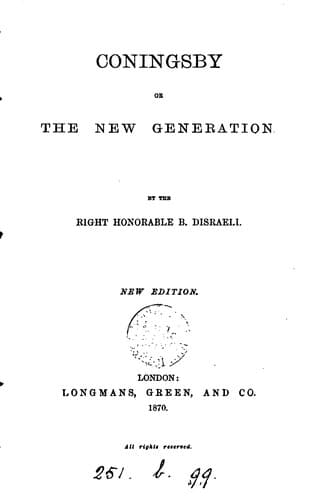
Coningsby; Or, The New GenerationDisraeli, Benjamin, Earl of Beaconsfield
General
Coningsby; Or, The New Generation
Disraeli, Benjamin, Earl of Beaconsfield
Great Britain -- Fiction; Political fiction; Politicians -- Fiction
Notwithstanding the fatigues of the morning, the evening was passed with
great gaiety at the Castle. The gentlemen all vowed that, far from being
inconvenienced by their mishaps, they felt, on the whole, rather better
for them. Mr. Guy Flouncey, indeed, did not seem quite so limber
and flexible as usual; and the young guardsman, who had previously
discoursed in an almost alarming style of the perils and feats of the
Kildare country, had subsided into a remarkable reserve. The Provincials
were delighted with Sidonia’s riding, and even the Leicestershire
gentlemen admitted that he was a ‘customer.’
Lord Monmouth beckoned to Coningsby to sit by him on the sofa, and spoke
of his approaching University life. He gave his grandson a great deal of
good advice: told him to avoid drinking, especially if he ever chanced
to play cards, which he hoped he never would; urged the expediency of
never borrowing money, and of confining his loans to small sums, and
then only to friends of whom he wished to get rid; most particularly
impressed on him never to permit his feelings to be engaged by any
woman; nobody, he assured Coningsby, despised that weakness more than
women themselves. Indeed, feeling of any kind did not suit the present
age: it was not _bon ton_; and in some degree always made a man
ridiculous. Coningsby was always to have before him the possible
catastrophe of becoming ridiculous. It was the test of conduct, Lord
Monmouth said; a fear of becoming ridiculous is the best guide in life,
and will save a man from all sorts of scrapes. For the rest, Coningsby
was to appear at Cambridge as became Lord Monmouth’s favourite grandson.
His grandfather had opened an account for him with Drummonds’, on whom
he was to draw for his considerable allowance; and if by any chance he
found himself in a scrape, no matter of what kind, he was to be sure to
write to his grandfather, who would certainly get him out of it.
‘Your departure is sudden,’ said the Princess Lucretia, in a low deep
tone to Sidonia, who was sitting by her side and screened from general
observation by the waltzers who whirled by.
‘Departures should be sudden.’
‘I do not like departures,’ said the Princess.
‘Nor did the Queen of Sheba when she quitted Solomon. You know what she
did?’
‘Tell me.’
‘She wept very much, and let one of the King’s birds fly into the
garden. “You are freed from your cage,” she said; “but I am going back
to mine.”’
‘But you never weep?’ said the Princess.
‘Never.’
‘And are always free?’
‘So are men in the Desert.’
‘But your life is not a Desert?’
‘It at least resembles the Desert in one respect: it is useless.’
‘The only useless life is woman’s.’
‘Yet there have been heroines,’ said Sidonia.
‘The Queen of Sheba,’ said the Princess, smiling.
‘A favourite of mine,’ said Sidonia.
‘And why was she a favourite of yours?’ rather eagerly inquired
Lucretia.
‘Because she thought deeply, talked finely, and moved gracefully.’
Public-domain text, read in full here on John Shaqi.
Reviews
Reviews
No reviews yet
Be the first to share your thoughts on this work.
Elsewhere in the archive
Join the Discussion
Join the discussion
Sign in to leave a comment or review.
Sign InorCreate an account