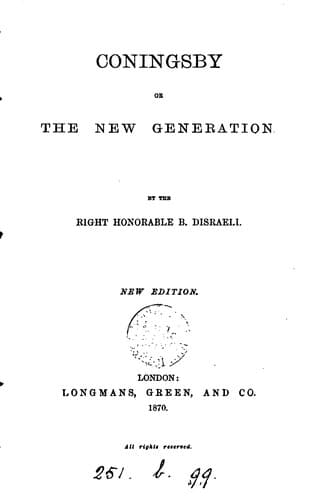
Coningsby; Or, The New GenerationDisraeli, Benjamin, Earl of Beaconsfield
General
Coningsby; Or, The New Generation
Disraeli, Benjamin, Earl of Beaconsfield
Great Britain -- Fiction; Political fiction; Politicians -- Fiction
‘But the passionate and creative genius, that is the nearest link to
Divinity, and which no human tyranny can destroy, though it can divert
it; that should have stirred the hearts of nations by its inspired
sympathy, or governed senates by its burning eloquence; has found a
medium for its expression, to which, in spite of your prejudices and
your evil passions, you have been obliged to bow. The ear, the voice,
the fancy teeming with combinations, the imagination fervent with
picture and emotion, that came from Caucasus, and which we have
preserved unpolluted, have endowed us with almost the exclusive
privilege of Music; that science of harmonious sounds, which the
ancients recognised as most divine, and deified in the person of their
most beautiful creation. I speak not of the past; though, were I to
enter into the history of the lords of melody, you would find it the
annals of Hebrew genius. But at this moment even, musical Europe is
ours. There is not a company of singers, not an orchestra in a single
capital, that is not crowded with our children under the feigned names
which they adopt to conciliate the dark aversion which your posterity
will some day disclaim with shame and disgust. Almost every great
composer, skilled musician, almost every voice that ravishes you with
its transporting strains, springs from our tribes. The catalogue is too
vast to enumerate; too illustrious to dwell for a moment on secondary
names, however eminent. Enough for us that the three great creative
minds to whose exquisite inventions all nations at this moment yield,
Rossini, Meyerbeer, Mendelssohn, are of Hebrew race; and little do your
men of fashion, your muscadins of Paris, and your dandies of London, as
they thrill into raptures at the notes of a Pasta or a Grisi, little do
they suspect that they are offering their homage to “the sweet singers
of Israel!”’
CHAPTER XVI.
It was the noon of the day on which Sidonia was to leave the Castle. The
wind was high; the vast white clouds scudded over the blue heaven; the
leaves yet green, and tender branches snapped like glass, were whirled
in eddies from the trees; the grassy sward undulated like the ocean with
a thousand tints and shadows. From the window of the music-room Lucretia
Colonna gazed on the turbulent sky.
The heaven of her heart, too, was disturbed.
She turned from the agitated external world to ponder over her inward
emotion. She uttered a deep sigh.
Slowly she moved towards her harp; wildly, almost unconsciously, she
touched with one hand its strings, while her eyes were fixed on the
ground. An imperfect melody resounded; yet plaintive and passionate. It
seemed to attract her soul. She raised her head, and then, touching
the strings with both her hands, she poured forth tones of deep, yet
thrilling power.
Public-domain text, read in full here on John Shaqi.
Reviews
Reviews
No reviews yet
Be the first to share your thoughts on this work.
Elsewhere in the archive
Join the Discussion
Join the discussion
Sign in to leave a comment or review.
Sign InorCreate an account