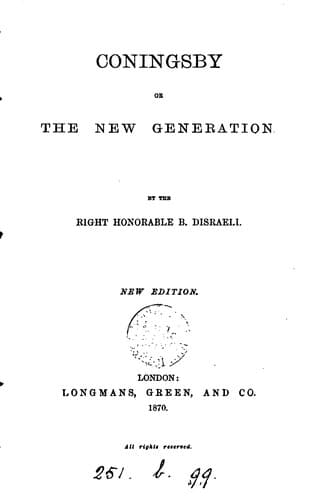
Coningsby; Or, The New GenerationDisraeli, Benjamin, Earl of Beaconsfield
General
Coningsby; Or, The New Generation
Disraeli, Benjamin, Earl of Beaconsfield
Great Britain -- Fiction; Political fiction; Politicians -- Fiction
An University life did not bring to Coningsby that feeling of
emancipation usually experienced by freshmen. The contrast between
school and college life is perhaps, under any circumstances, less
striking to the Etonian than to others: he has been prepared for
becoming his own master by the liberty wisely entrusted to him in his
boyhood, and which is, in general, discreetly exercised. But there were
also other reasons why Coningsby should have been less impressed with
the novelty of his life, and have encountered less temptations than
commonly are met with in the new existence which an University opens to
youth. In the interval which had elapsed between quitting Eton and going
to Cambridge, brief as the period may comparatively appear, Coningsby
had seen much of the world. Three or four months, indeed, may not seem,
at the first blush, a course of time which can very materially influence
the formation of character; but time must not be counted by calendars,
but by sensations, by thought. Coningsby had felt a good deal, reflected
more. He had encountered a great number of human beings, offering a vast
variety of character for his observation. It was not merely manners, but
even the intellectual and moral development of the human mind, which
in a great degree, unconsciously to himself, had been submitted to his
study and his scrutiny. New trains of ideas had been opened to him; his
mind was teeming with suggestions. The horizon of his intelligence had
insensibly expanded. He perceived that there were other opinions in the
world, besides those to which he had been habituated. The depths of his
intellect had been stirred. He was a wiser man.
He distinguished three individuals whose acquaintance had greatly
influenced his mind; Eustace Lyle, the elder Millbank, above all,
Sidonia. He curiously meditated over the fact, that three English
subjects, one of them a principal landed proprietor, another one of the
most eminent manufacturers, and the third the greatest capitalist in the
kingdom, all of them men of great intelligence, and doubtless of a
high probity and conscience, were in their hearts disaffected with the
political constitution of the country. Yet, unquestionably, these were
the men among whom we ought to seek for some of our first citizens.
What, then, was this repulsive quality in those institutions which we
persisted in calling national, and which once were so? Here was a great
question.
Public-domain text, read in full here on John Shaqi.
Reviews
Reviews
No reviews yet
Be the first to share your thoughts on this work.
Elsewhere in the archive
Join the Discussion
Join the discussion
Sign in to leave a comment or review.
Sign InorCreate an account